

Cross-Border Payments in Latin America: Country Readiness Guide
Latin America’s domestic payment networks can deliver fast local payouts, but the cross-border operation still depends on funding, FX, and country-specific data. Build a country readiness matrix before promising recipients a delivery time.
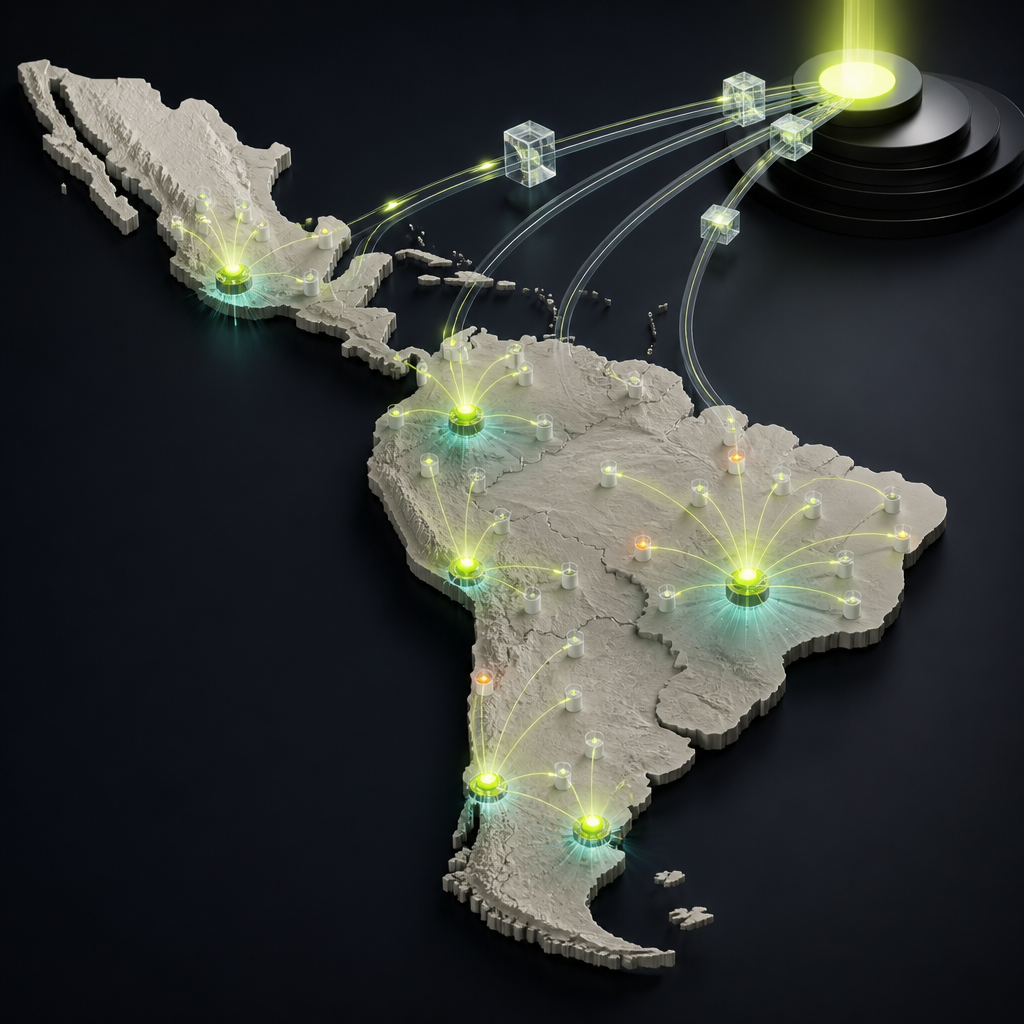
Cross-border payments in Latin America typically combine international funding, currency conversion, compliance checks, and a local transfer to the recipient. For recurring vendor, contractor, or seller payouts, the practical approach is to fund an authorized provider that can deliver into the destination country’s banking network. Brazil’s Pix and Mexico’s SPEI can accelerate that final transfer; they do not, by themselves, complete the international transaction.
For teams paying hundreds of recipients, the central challenge is country readiness: can each payment reach the right account, in the agreed currency and amount, with the required documentation? Treat Latin America as a portfolio of country-specific operating models, not a single payout market.
Separate the international payment from local delivery
A payout into Latin America has distinct dependencies:
- Funding: money reaches the provider or an available prefunded balance.
- FX and compliance: the provider converts currency and completes applicable transaction checks.
- Local delivery: a participating institution submits the domestic payment.
- Confirmation: the operator receives evidence of credit, rejection, or return.
These steps may overlap. With prefunding, for example, local delivery can occur before the provider replenishes its own settlement position. That improves delivery speed but shifts the burden toward liquidity management.
PCMI’s regional payments analysis distinguishes domestic real-time payment adoption from cross-border interoperability. The operational implication is important: access to an instant domestic network is not proof of an instant international service.
Ask providers to identify the entity handling FX, the institution delivering locally, and the event their status system calls “paid.” A submission acknowledgment should not become a recipient-facing confirmation of available funds.
Build a country-specific recipient data matrix
Start with the recipient’s legal name, individual or business status, destination currency, payment purpose, and verified receiving details. Then apply country and route-specific fields.
The matrix below is a planning baseline, not a universal regulatory checklist. Exact requirements depend on the provider, receiving institution, payment purpose, and recipient type. Confirm the accepted data schema before collecting sensitive information.
| Destination | Receiving details to confirm | Identity data to confirm | Operational check |
|---|---|---|---|
| Brazil | Pix key or supported bank-account details | Legal name; CPF for individuals or CNPJ for businesses | Resolve the destination and check ownership |
| Mexico | CLABE for the supported SPEI route | Legal name; RFC where required | Confirm account eligibility and limits |
| Colombia | Bank, account number, and account type; key if supported | Document type and number; NIT for businesses where required | Verify bank-transfer versus Bre-B coverage |
| Argentina | CBU for bank accounts or CVU for supported payment accounts | Legal name; CUIT or CUIL as applicable | Confirm currency and current FX documentation |
| Chile | Bank, account number, and account type | Legal name and RUT | Validate the precise account product |
| Peru | CCI for interbank transfers or supported account details | Legal name; DNI, RUC, or applicable identity document | Confirm account currency and receiving route |
Do not use a single free-text “bank details” field across these markets. Store identifiers as text, preserve leading zeros, and validate each field according to the selected destination and payment method. Passing a format check does not establish account ownership.
A self-service vendor onboarding portal can centralize collection and corrections. Payment-detail changes should still require verification independent of the change request, especially when a recipient replaces an established account.
Understand the country-specific delivery boundaries
Brazil: Pix is the delivery method, not the whole corridor
Pix can provide fast domestic delivery, including outside traditional banking hours. But an international payer still needs a supported funding route, conversion into reais where applicable, and an authorized arrangement for the cross-border transaction.
Confirm whether the provider accepts Pix keys, bank-account details, or both. Establish what happens when the resolved beneficiary does not match the approved recipient. A valid key should not override an ownership discrepancy.
Mexico: SPEI access must include the receiving account
For a supported Mexican bank payout, CLABE identifies the receiving account. The provider must also support the recipient’s account type, transaction amount, and use case.
BlindPay’s explanation of Pix and SPEI delivery illustrates the distinction between moving value internationally and landing local currency in a bank account. That distinction applies whether the upstream funding uses bank money or stablecoins.
Colombia: confirm the actual route behind the coverage claim
Do not interpret “Colombia supported” as confirmation that every recipient can receive through Bre-B. Ask whether the specific service uses conventional bank transfers or supports the newer interoperable instant-payment infrastructure, and which institutions and identifiers it accepts.
Build the onboarding form from that answer. Collecting a payment key that the selected provider cannot use creates unnecessary rework.
Argentina, Chile, and Peru: avoid a regional speed promise
These markets have distinct account structures and payment systems. ACI Worldwide’s research on their real-time payment development describes separate modernization paths, not a uniform regional network.
For Argentina, verify current FX eligibility and supporting documentation before committing to a conversion route. For Chile and Peru, confirm account type, receiving currency, and the provider’s actual processing window. Domestic transfer availability does not establish the end-to-end international delivery schedule.
Control FX around the recipient’s contractual amount
Decide what the payment obligation means before comparing fees:
- Fixed destination amount: the recipient must receive the agreed local-currency amount; the payer absorbs conversion movements and applicable charges.
- Fixed source amount: the payer sends the agreed source-currency amount; the contract must explain how conversion and deductions affect receipt.
- Foreign-currency receipt: verify that the receiving account and route support that currency rather than automatically converting it.
Compare quotes using the same funding method, destination amount, and quote time. Request the total source debit, exchange rate, separately charged fees, expected deductions, and quote expiry. A low transfer fee can coexist with an unfavorable conversion rate.
Also establish what happens after failure. Does a returned payment remain in destination currency, or does the provider convert it back? A second conversion can create an FX difference even when the transfer fee is refunded.
Fund the promise, not just the payment file
An always-available local rail cannot spend an empty payout balance. Map source-bank holidays, funding cutoffs, conversion availability, local liquidity, and provider limits separately.
Set liquidity buffers from expected obligations and observed replenishment times, rather than applying an arbitrary balance across every market. Brazil and Mexico may require different funding arrangements even when both support fast local delivery. The principles in real-time treasury management are particularly relevant when cash sits across currencies and providers.
Stablecoins may serve as an intermediate funding or settlement mechanism, but they do not eliminate conversion, compliance, or local liquidity requirements. Confirm the lawful route for the jurisdiction and direction of payment, the responsible regulated entities, redemption terms, and the recipient’s final asset. A bank-account payout and a transfer to a self-custody wallet are different services.
Hypothetical example: one regional batch, separate readiness gates
Consider a company paying contractors in Brazil, Mexico, and Colombia from a dollar-funded treasury account. Its contracts promise fixed local-currency amounts.
The Brazilian records contain verified Pix destinations, but the provider’s available reais balance is insufficient. Mexico has sufficient funding, but a contractor’s changed CLABE remains unverified. The Colombian records are approved for bank transfers, not for a key-based instant route.
The correct response is not to label the whole batch “ready” or switch every payment to another rail. Release only funded, verified instructions; hold the changed account for independent verification; replenish the Brazilian balance; and communicate a delivery estimate based on the confirmed Colombian route.
Track each obligation independently so that a delayed payment is not accidentally resubmitted alongside already-completed payouts.
Latin America payout launch checklist
- Document each country configuration: sending entity, recipient type, purpose, source currency, destination currency, and local delivery method.
- Validate the recipient schema: required identifiers, account ownership checks, supported account types, and secure correction procedures.
- Confirm legal and FX responsibilities: identify the entities performing conversion, screening, and local delivery.
- Define recipient economics: agreed net amount, quote expiry, deductions, and return-conversion treatment.
- Test funding dependencies: establish what happens outside source-bank hours and when local liquidity is depleted.
- Test exception evidence: distinguish accepted, pending, credited, rejected, and returned payments; prevent duplicate retries.
- Reconcile by country: connect the payable, source debit, FX trade, fees, destination amount, and delivery reference.
Make country readiness the release condition
Reliable cross-border payments in Latin America require more than selecting a fast rail. Recipient data, authorized FX, local funding, and delivery evidence must align for each country and payment.
Build that readiness matrix before expanding the next payout batch. Then explore Payouts.com’s payout automation to coordinate global payment workflows, using your country requirements as the basis for a corridor-specific review.
Created with AI assistance. Sources are linked in the article; this content is general information, not legal, tax, or financial advice.
Discussion
3 commentsRelated resources

Real-Time Treasury Explained: How Finance Teams Are Rethinking Liquidity in Motion
Real-time treasury moves beyond batch reporting and end-of-day snapshots, giving CFOs and controllers a live, actionable picture of every dollar in motion. This guide explains the mechanics, the operational payoff, and what it takes to build it.

CJ Affiliate Account: Setup, Payment Access, and Controls
A CJ Affiliate account connects publishers and advertisers, but account access does not mean commissions are ready to spend. Here is how to separate registration, program approval, payment eligibility, and bank receipt.

Mobile Pay International Transfer: From App to Usable Funds
A mobile app can initiate an international transfer without guaranteeing mobile-wallet delivery. Learn how to verify the destination, recipient requirements, and usable funds before scaling business payouts.
Run your entire money cycle on one ledger
Global payouts, AP/AR automation, and AI agents with their own wallets and spend limits.
Get started
The distinction between submission acknowledgment and actual funds availability is critical and most providers are terrible at surfacing this in their API response. We've had to build our own status interpretation layer because 'paid' from the webhook doesn't mean the recipient can withdraw.
The point about not using a single free-text bank details field is huge. We built our vendor portal that way initially and the cleanup work for Brazilian CPF/CNPJ mismatches alone cost us two weeks of AP time every quarter. Now we have country-specific forms with validation and the error rate dropped by about 80%.
How are people handling the FX documentation requirement for Argentina in practice? We have a local provider who claims they manage it but we still get random rejections on conversions above certain thresholds, and their explanation is always vague about what triggered the block.