

ACH Wire Instructions: Required Fields and a Verification Checklist
ACH and wire instructions are separate sets of banking details, not a single payment method. Use these field templates and verification controls to build payment-ready recipient records.
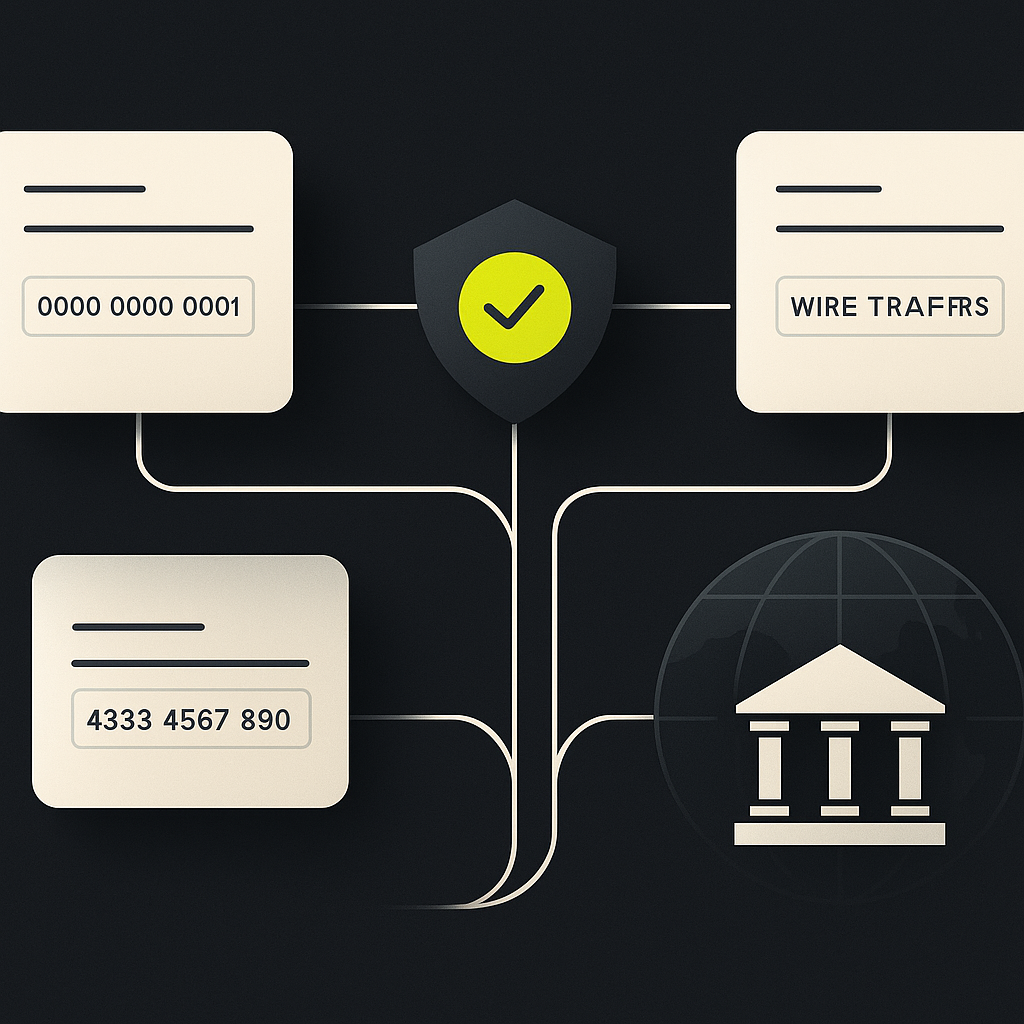
ACH wire instructions should specify either ACH or wire transfer—not leave the payment method ambiguous. For a U.S. ACH credit, collect the recipient’s account-holder name, bank name, ACH routing number, account number, and account type. For a wire, obtain the bank’s wire-specific instructions, including beneficiary details, the applicable bank identifier, and any intermediary or further-credit information.
The same account may accept both methods, but its ACH and wire routing numbers may differ. Never assume that details copied from a check or a previous ACH payment are valid wire instructions.
For finance teams managing international recipients, the practical challenge is turning documents and emails into verified, rail-specific records. This guide provides a collection template and a release checklist—not a substitute for the receiving bank’s instructions.
Start with an explicit payment-method label
ACH and wires are distinct payment methods. ACH processes electronic credits and debits through the U.S. Automated Clearing House network; wires use separate banking infrastructure. Plaid’s ACH-versus-wire overview explains the underlying distinction.
A request labeled “ACH/wire details” is therefore incomplete. Before entering banking information, ask the recipient to identify:
- Payment method: U.S. ACH credit, U.S. domestic wire, international wire, or a specific local transfer method.
- Receiving country and currency: Where the account is held and which currency it can receive through that method.
- Account-holder identity: The name on the receiving account, which may differ from a trading name.
- Special handling: Any intermediary bank, collection-account restriction, or mandatory reference.
Do not use a single routing-number field shared across every payment method. A recipient should be able to maintain separate ACH and wire instruction sets without one overwriting the other.
Required fields for ACH and wire instructions
The following is a collection checklist. Exact requirements vary by bank, payment provider, destination, and account structure. Follow the receiving bank’s instructions and the sending provider’s field requirements.
| Field | U.S. ACH credit | U.S. domestic wire | International wire | Operational check |
|---|---|---|---|---|
| Account-holder name | Collect | Collect | Collect | Resolve trading-name differences |
| Bank name | Collect | Collect | Collect | Match bank identifiers |
| Routing or bank identifier | ACH routing number | Wire routing number | SWIFT/BIC and local codes as required | Validate for the selected method |
| Account identifier | Account number | Account number | IBAN or account number as applicable | Preserve leading zeros |
| Account type | Checking or savings | As requested | As requested | Confirm supported account type |
| Beneficiary and bank addresses | As requested | As requested | Commonly requested | Use required structured fields |
| Receiving currency | USD for standard U.S. ACH | Confirm USD instructions | Confirm supported currency | Identify conversion requirements |
| Intermediary and further-credit details | Only if explicitly supported | If instructed | If instructed | Keep each party separate |
| Payment reference | Invoice or recipient reference | Invoice or recipient reference | Reference or purpose details as required | Distinguish optional from mandatory |
ACH credit instruction template
Use the following labels in a secure collection form. These are fields to complete, not sample banking coordinates.
- Payment method: U.S. ACH credit.
- Account-holder legal name: Name registered on the account.
- Bank name: Receiving financial institution.
- ACH routing number: Bank-confirmed routing number for incoming ACH credits.
- Account number and type: Enter separately; retain leading zeros.
- Remittance reference and contact: Invoice-matching information and a contact for payment questions.
- Instruction source and effective date: Where the details came from and when they should apply.
Receiving an ACH credit is not the same as authorizing an ACH debit. If your business intends to pull money from an account, account details alone are not sufficient authorization.
Wire instruction template
- Payment method: U.S. domestic wire or international wire.
- Beneficiary: Account-holder name, address, and account number or applicable IBAN.
- Beneficiary bank: Name, address, and the wire routing number or applicable SWIFT/BIC and local bank codes.
- Currency: Currency covered by these specific receiving instructions.
- Intermediary bank: Details exactly as supplied, when required.
- Further credit to: Ultimate recipient name, account identifier, and reference, when required.
- Payment reference or purpose: Required destination information and invoice reference.
Keep intermediary-bank details separate from beneficiary-bank details. Likewise, a further-credit identifier is not automatically the beneficiary account number. Confirm how the sending bank maps these instructions into its payment form.
Validate the routing number without overstating what validation proves
U.S. ACH and wire routing numbers use the same nine-digit format, but format alone does not establish that a number supports the intended payment method. Some banks use the same number for both; others use different numbers. This routing-number comparison describes that distinction.
Apply separate checks rather than treating “valid bank details” as a single result:
- Format: Does the identifier meet the applicable structural requirements?
- Routing: Does the institution support the selected method through that identifier?
- Account relationship: What evidence connects the account to the intended recipient?
- Authority: Was the person supplying or changing the instructions authorized to do so?
A valid routing number does not prove account ownership. A successful small test payment demonstrates reachability, not necessarily the legitimacy of the person requesting the change. Use such checks as evidence with defined limitations.
Handle international recipients without forcing U.S. fields
Recipient location and receiving-account location are different facts. An overseas contractor may provide U.S. receiving details, while a U.S. supplier may request payment to a foreign account.
Ask which payment methods the specific account supports. A provider-issued USD collection account may have restrictions on payer types, currencies, or incoming transfers. USD denomination alone does not establish ACH eligibility.
For foreign accounts, collect destination-specific identifiers rather than requiring a U.S. routing number. IBAN is not universal, and SWIFT is a messaging network—not a guarantee of a direct bank-to-bank settlement path. International wires can involve intermediary institutions.
Cross-border arrangements can also raise International ACH Transaction classification questions. Ask the originating bank how it classifies the arrangement rather than deciding solely from the presence of U.S. account details. For choosing the delivery method, use a separate local-rail versus SWIFT routing policy.
Make instruction changes invalidate payment readiness
The highest-risk moment is often not initial onboarding but a later request to replace approved banking details. A plausible invoice attachment or familiar email thread is not independent verification.
Nacha’s guidance on expanded fraud-monitoring responsibilities describes risk-based processes for detecting fraudulently initiated ACH entries. Treat that as a reason to examine the complete workflow, not as proof that one particular verification service is universally required.
Use this change-control sequence:
- Collect securely: Use an authenticated channel rather than circulating bank details in shared spreadsheets. Payouts.com’s Vendor Portal supports self-service vendor onboarding.
- Verify independently: Contact an authorized recipient representative through previously established details—not a phone number supplied in the change request.
- Separate responsibilities: Have someone other than the editor approve the banking change.
- Version the instructions: Retain the previous record, new record, verification evidence, effective date, and approver.
- Recheck queued payments: Hold affected payments until approval covers the new destination.
Useful design rule: bind payment approval to an instruction version, not just a vendor ID. Otherwise, an approved invoice can silently inherit a newly edited destination.
Hypothetical example: a valid change that still needs a hold
A supplier changes its wire account after an invoice is approved but before payment release. The new details are independently verified. Even so, the queued payment should not automatically switch destinations: its approval referenced the previous instructions. Revalidate the payment against the approved replacement record, then release it with an audit trail.
Final checklist before releasing payment
- The payment method is explicit, not labeled only “ACH/wire.”
- The routing details are appropriate for that method.
- The account-holder name, receiving currency, and account restrictions are resolved.
- Required intermediary, further-credit, and reference fields are mapped correctly.
- Recent changes have independent verification and approval.
- The queued payment uses the approved instruction version.
- No earlier attempt remains unresolved before a replacement is submitted.
If a payment fails, preserve the original instructions, provider reference, and failure message. Do not simply switch methods or resend: first establish whether the original payment was rejected, returned, or remains pending.
The next step is to audit your recipient form and payment-release logic against this checklist. When evaluating Payouts.com Payouts Automation, use these requirements to discuss how instruction collection, approval, execution, and reconciliation should connect. Good instructions are not merely complete bank details; they are bank details approved for a specific recipient, method, currency, and payment.
Created with AI assistance. Sources are linked in the article; this content is general information, not legal, tax, or financial advice.
Discussion
4 commentsRelated resources

Local Payment Rails vs SWIFT: Build a Corridor Routing Policy
The right payout route depends on the recipient’s currency, bank reachability, funding, and payment purpose—not just the transfer fee. Here is how finance teams can turn that decision into a repeatable corridor routing policy.
Contractor Payment Terms: From Contract to Cross-Border Credit
Net 30 is only part of the agreement. Learn how to define contractor payment terms that connect invoice acceptance, currency, fees, and payment completion across borders.

Amazon Affiliate Account: Setup and Cross-Border Readiness
Opening an Amazon Associates account is only part of becoming ready to receive commissions. Here is how to align account ownership, tax information, storefront participation, and international bank details.
Run your entire money cycle on one ledger
Global payouts, AP/AR automation, and AI agents with their own wallets and spend limits.
Get started
The point about not assuming check details are valid wire instructions is something we learned the hard way. A vendor gave us their deposit slip info and we used it for an urgent international wire—bounced back three days later because the routing number only handled ACH. Cost us fees and a very awkward conversation with their finance team.
The separate field requirement for ACH vs wire routing is spot on but creates a UI problem—most ERP vendor modules still have a single "routing number" field that gets reused across payment types. We ended up building a custom table just to store method-specific instructions because NetSuite's native beneficiary record couldn't distinguish between the two.
We hit the same wall with SAP and ended up doing method-specific beneficiary master records with workflow rules to prevent cross-contamination. The real pain is when someone updates ACH details and your wire team finds out mid-payment that they've been overwritten.
Curious how others handle the authority validation piece mentioned at the end. We require dual sign-off on any banking detail changes in our vendor master file, but that doesn't solve the problem when the initial email request comes from a compromised account. Are people using out-of-band verification calls for every change, or only above certain payment thresholds?