

AI-Driven Fraud Detection: From Risk Scores to Defensible Decisions
A fraud score is not proof, and an investigation agent is not a payment approver. Here is how finance teams can turn AI signals into evidence-backed decisions without creating an unmanageable alert queue.
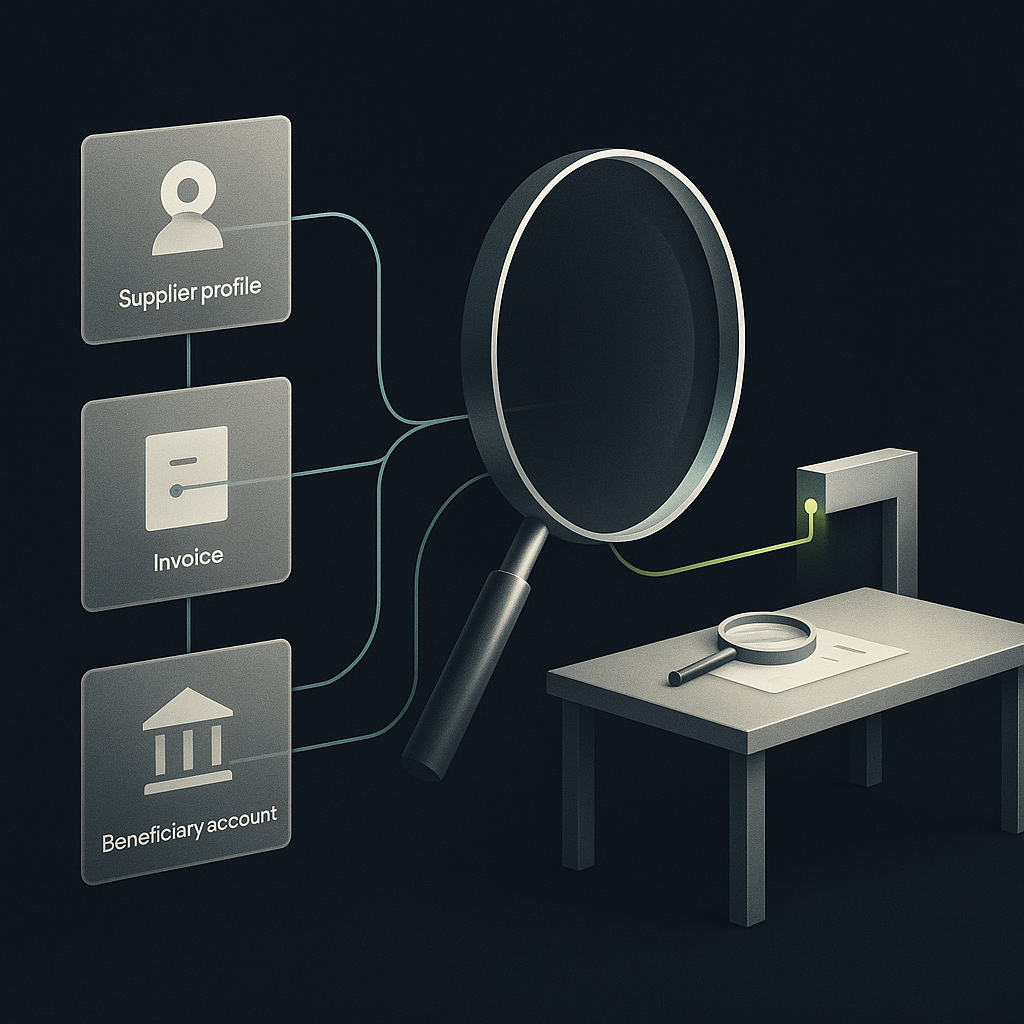
AI-driven fraud detection uses machine learning to identify suspicious patterns across transactions, identities, documents, and account activity. In finance operations, it can connect signals that isolated checks miss: a supplier contact change, an unfamiliar beneficiary, and an unusual payment request that each looks plausible alone.
Its value is not simply detecting more anomalies. It is helping teams distinguish suspicious activity from legitimate exceptions before money moves. For CFOs and controllers, the practical design principle is clear: use models to identify risk, agents to assemble evidence, and explicit policies to determine who can act.
How AI-driven fraud detection works
A useful system combines several techniques rather than replacing every existing rule with a single model.
- Supervised learning finds patterns associated with previously labeled fraud and legitimate activity. Its usefulness depends on representative data and reliable outcomes.
- Anomaly detection identifies departures from an established baseline, such as a supplier suddenly changing payment behavior. Unusual does not necessarily mean fraudulent.
- Relationship analysis connects entities through shared bank accounts, addresses, contacts, or other identifiers. Shared details may reveal coordinated abuse—or a legitimate group structure.
- Document and language analysis extracts information and identifies inconsistencies across invoices, contracts, and correspondence. Extracted claims still need verification against trusted records.
- Deterministic rules enforce nonnegotiable requirements, such as mandatory verification of a beneficiary change. A low model score should not override them.
The underlying data must connect supplier identity, invoice, approval, beneficiary, and payment events. A model cannot reliably interpret a change if the vendor portal and ERP identify the same supplier differently. Evaluate financial-system integrations for identifier consistency, timestamps, and field-level change history—not merely whether records synchronize.
Detection models and investigative agents have different jobs
A detection model produces a score, classification, or anomaly signal. An investigative agent can retrieve records, compare events, request missing evidence, and draft a case summary. Generative AI should not turn an unexplained score into a convincing but unsupported narrative.
This distinction is reflected in IBM's announcement of agentic capabilities for Safer Payments: agents can query payment-fraud intelligence through APIs. Access to evidence makes investigation possible; it does not establish that the agent's conclusion is correct.
Map each signal to evidence and a permitted response
A risk signal becomes operationally useful only when it identifies what to inspect next. The following table is a suggested investigation design, not a claim that any individual signal proves fraud.
| Signal | Possible legitimate explanation | Evidence to retrieve | Suggested response |
|---|---|---|---|
| New beneficiary after contact change | Supplier bank migration | Change history and independent verification | Hold pending verification |
| Several suppliers share an account | Common parent or collection agent | Ownership and payment mandate records | Investigate relationship |
| Unusual amount or payment timing | Seasonal order or agreed prepayment | Contract, purchase order, and history | Review commercial context |
| Invoice conflicts with master data | Outdated template or extraction error | Original document and approved records | Resolve discrepancy |
| Agent acts outside expected workflow | New authorized automation | Agent identity and delegated authority | Restrict action pending review |
Several weak signals can justify investigation without establishing fraud. Conversely, one mandatory-control failure may require a hold even when the model considers the transaction ordinary.
Why correct credentials do not establish legitimate intent
Authentication answers who accessed a system. It does not necessarily explain why they requested a payment.
The Thomson Reuters Institute describes “all-green” fraud, where a legitimate account holder uses familiar credentials and devices but acts under a scammer's influence. For corporate finance, the implication is that normal login activity cannot substitute for validating the business purpose and destination of funds.
Agent-initiated transactions introduce another limitation. Human behavioral baselines may not fit software that works continuously or submits transactions in rapid batches. The IMF's note on agentic payments highlights the need to verify both an agent's identity and its delegated authority.
Evaluate human- and agent-initiated activity separately where their behavior differs materially. Otherwise, normal automation may flood the queue while unauthorized machine activity disappears inside an overly broad “automated” category.
Where investigative autonomy should stop
A safe starting point is read-only evidence gathering. An agent can retrieve approved records, construct a timeline, identify missing information, and draft a recommendation with references to the underlying evidence.
Autonomy can expand selectively to reversible actions, such as opening a case or routing a request. Temporary payment holds need defined authority, an accountable owner, and a review deadline: delaying a legitimate supplier payment also has consequences.
For suspicious beneficiary changes, conflicting evidence, or policy exceptions, require an authorized human decision. Do not let the same agent modify the vendor record, verify its own modification, and release the resulting payment.
These boundaries complement the broader accounts payable fraud prevention control framework. Detection prioritizes scrutiny; it does not replace segregation of duties or independent verification.
Treat incoming documents as evidence, not instructions
Supplier emails and invoices are untrusted inputs. An embedded instruction telling an agent to ignore policy or update bank details must not gain authority merely because it appears inside a document being analyzed.
Enforce tool permissions outside the language model. Restrict available actions, minimize access to sensitive data, and log the records used to support each recommendation. A well-written case summary is not an audit trail unless its claims can be traced to evidence.
Test decision quality, not dashboard accuracy
Fraud is typically uncommon relative to legitimate activity, so overall classification accuracy can be misleading. A model that labels almost everything legitimate may appear accurate while missing the cases that matter.
Ask for a measurement plan covering:
- Alert precision: the share of reviewed alerts confirmed as fraud. Track policy violations separately rather than relabeling them as fraud.
- Detection coverage: the share of known fraud cases detected. Acknowledge that undiscovered fraud makes this incomplete.
- Legitimate-payment friction: unnecessary holds, supplier escalations, and time to release valid payments.
- Investigation effort: analyst time per resolved case, including checking an agent's work.
- Economic outcomes: confirmed losses, recoveries, operating costs, and payment-delay costs. Do not treat the value of every flagged transaction as prevented loss.
Compare performance with existing rules at a similar review capacity. A system that finds more fraud by generating an unmanageable queue has not necessarily improved the operation.
Use a later, untouched time period for evaluation, and supply only information available at the original decision point. Including later chargebacks, investigation notes, or corrected beneficiary records creates hindsight leakage.
Maintain distinct outcome labels: confirmed fraud, legitimate exception, operational error, policy breach, and unresolved. An analyst closing an alert without investigation is not proof that the transaction was legitimate.
Hypothetical example: a supplier's changed bank account
A longstanding supplier submits an ordinary invoice shortly after changing its contact email and beneficiary account. The invoice matches the purchase order, and the amount is consistent with previous orders.
The model flags the sequence of changes. A read-only agent retrieves the change log, onboarding records, and payment history, then reports that independent verification is missing. It does not claim the supplier is fraudulent.
The reviewer contacts the supplier using a previously established channel—not details supplied in the change request. If the change is valid, the team records a legitimate exception. If it is malicious, the team records confirmed fraud and the supporting evidence. Either outcome improves future evaluation without making the model's suspicion its own proof.
A practical deployment checklist
- Choose a specific fraud scenario. Define the loss mechanism, available evidence, and existing control baseline.
- Check data readiness. Confirm entity matching, event timestamps, change history, and permitted data use.
- Define the action contract. Document what the model recommends, what the agent may execute, and who resolves exceptions.
- Run in shadow mode. Compare recommendations with actual decisions without automatically affecting payments.
- Review blind spots. Examine sampled non-alerts as well as alerts; measure results by relevant workflow and payment segment.
- Set operating limits. Assign queue ownership, review deadlines, fallback procedures, and stop conditions for unreliable data or unexplained alert spikes.
- Control changes. Version models, prompts, tools, thresholds, and policies; require evaluation before expanding authority.
Make evidence quality the buying criterion
The strongest AI-driven fraud detection program is not the one with the most confident score. It is the one that can explain what triggered scrutiny, identify missing evidence, preserve decision authority, and demonstrate useful outcomes within the team's capacity.
Payouts.com brings money movement, AP/AR automation, and AI digital employees into a financial operating system built around one ledger. When evaluating digital employees for finance operations, start with a bounded evidence-gathering workflow. Ask for a demonstration using your exceptions, permissions, and review requirements before expanding autonomy.
Created with AI assistance. Sources are linked in the article; this content is general information, not legal, tax, or financial advice.
Discussion
36 commentsRelated resources

Accounts Payable Fraud Prevention Controls That Survive Payment Release
An approved invoice can still become a fraudulent payment. Build controls that preserve authorization from vendor setup through bank release—and test whether your AP software actually enforces them.

QuickBooks AI Invoice Generator: From Draft to Ledger
QuickBooks offers several AI-assisted invoicing routes, but generating a document is not the same as recording a receivable. Here is how to choose a workflow and control what happens next.

AI Invoice Data Extraction: Build a Reliable AP Data Contract
Reading an invoice is not the same as creating a reliable payable. Give AI extraction a clear data contract so every field carries the evidence, validation, and permissions needed for its next use.
Run your entire money cycle on one ledger
Global payouts, AP/AR automation, and AI agents with their own wallets and spend limits.
Get started
The recommendation to evaluate integrations for identifier consistency and field-level change history rather than just sync status is spot on. We've been running fraud models for six months and only recently discovered that our vendor portal assigns different IDs than our ERP for the same supplier after a merge, which means the model can't actually track behavioral changes reliably. That data quality work should have come first.
We had a similar issue where our procurement system and GL used completely different vendor numbering schemes. The fraud model couldn't track changes reliably until we built a cross-reference table and started logging every identifier mapping with timestamps. Not glamorous work but absolutely necessary before any detection logic makes sense.
We had the exact same problem and it took us weeks to even realize it was happening. The fraud signals were useless because the model couldn't tell when a 'new' supplier was actually just the same entity with a different ID. Had to build a cross-reference table manually before any of the anomaly detection became reliable.
The point about treating incoming documents as untrusted inputs is something we need to hammer into our workflows. We've seen cases where AP staff assume a PDF invoice is inherently more legitimate than an email request, when both can be equally fabricated. The real control should be matching against the purchase order and validating destination changes through a separate channel, not the document format itself.
Completely agree. We actually stopped differentiating by file format entirely and now route anything that requests a vendor change through the same verification workflow, whether it's a PDF, email, portal submission, or phone call. Format tells you nothing about authenticity.
Exactly. We built a rule that any beneficiary change request, regardless of format, triggers the same verification workflow. PDF letterhead is trivial to fake now. The control has to be matching against what we independently know about the supplier, not the polish of the incoming document.
The part about evaluating human-initiated and agent-initiated activity separately is something we're wrestling with now. Our current anomaly detection just buckets everything by user, so our RPA bot that runs nightly looks 'normal' even when it starts doing things it shouldn't, and our finance team's legitimate but infrequent large payments get flagged constantly. Anyone actually implemented separate baselines for this without creating two completely different monitoring systems?
We solved this by creating separate behavioral profiles for each agent type and tagging every transaction with the originating process ID. Once you split the baselines, you can actually see when a scheduled job starts hitting unexpected endpoints or volumes. The setup overhead is real though.
We hit the same thing. The fix for us was tagging agent transactions with the specific workflow ID and building baseline profiles per workflow, not per agent identity. That way when the nightly reconciliation bot suddenly starts initiating payment approvals instead of just posting journal entries, it triggers immediately.
The distinction between anomaly detection and actual fraud is crucial. We've had too many cases where a seasonal supplier billing pattern got flagged as suspicious, and the operations team wanted to just turn down the sensitivity. The real issue was that we hadn't built in any way for the system to learn what 'legitimate exception' looks like in our specific business context.
We handled this by building feedback loops directly into the workflow. When a flagged transaction gets cleared by AP, they categorize the reason (seasonal, contract change, new supplier relationship, etc). That gets fed back to tune thresholds for specific supplier segments rather than just turning down global sensitivity.
This is why the article's recommendation to map each signal to specific evidence is so important. Instead of just tuning sensitivity up or down, you need to define what constitutes legitimate seasonal behavior and give the system a way to recognize it—contract terms, historical payment windows, or even a simple seasonal flag in the vendor record. Otherwise you're just guessing at the right threshold.
The recommendation to keep investigative agents read-only initially is smart, but we're finding the real challenge is defining what counts as 'reversible' once you move beyond that. Opening a case feels safe, but routing a request can effectively block a payment if it goes to someone on vacation or outside the org chart. We ended up needing explicit SLAs and fallback owners for every routing destination before we felt comfortable automating that step.
We treat routing differently depending on whether it's adding a reviewer to the workflow or actually changing the approval path. The former is logged but doesn't need special authority; the latter requires the same approval level as a manual hold because it can effectively block payment. The key is making sure every routing action has a defined timeout and fallback owner.
Good point. We handle this by treating routing as a decision action, not just evidence gathering. Every routing target gets a coverage rule—if primary reviewer is out, it goes to their designated alternate automatically. The agent can suggest the route but a standing delegation matrix actually controls it.
The read-only evidence gathering boundary makes sense as a starting point, but I wonder how long teams actually stay there before pressure mounts to automate the next step. We're piloting investigation agents now and already getting questions about why we can't just auto-approve low-risk cases if the agent has assembled all the right documentation.
That pressure is real, but I'd push back on auto-approving anything that touches vendor master data or bank details, even if the score looks clean. The risk asymmetry is just too high—you save maybe 15 minutes of review time but expose yourself to a six-figure wire going to the wrong account.
That pressure is real, but I'd push back on auto-approving anything that touches vendor master data or beneficiary info, regardless of score. The moment you collapse investigation and approval into one step, you've lost segregation of duties. Low-risk cases can get faster human review, not no review.
The table mapping signals to evidence and response is probably the most practical thing I've seen on this topic. We're piloting a fraud detection layer now and the biggest debate has been defining what action the system can take automatically versus what gets queued for review. Having that framework—signal, legitimate explanation, evidence to pull, and permitted response—gives us something concrete to configure around instead of just tuning score thresholds in a vacuum.
We found the hardest part is actually getting alignment across teams on those boundaries. AP operations wants to minimize false positives and delays, treasury is conservative on new beneficiaries, and IT wants everything automated. The framework helps but you still need someone with authority to make the final call on where each signal falls.
Completely agree. We ended up building ours backward—started with every possible action the system could theoretically take, then forced each one through a 'who's accountable if this goes wrong' discussion. That killed about half the automation ideas immediately, but what survived actually works in production without creating liability confusion.
The section on credential authentication vs. intent validation is something we've struggled with internally. We still see a lot of resistance to adding friction after login when the user 'looks' legitimate, but the all-green fraud pattern is exactly what bit us twice in Q3. How are others balancing this without making every payment feel like a compliance audit?
We implemented a lightweight secondary confirmation workflow for anything that changes payment routing, even if it's the same user who normally processes those requests. It's literally a Slack ping to their manager with transaction details and a 15-minute window to approve or flag. Adds maybe 20 minutes to the process but it's caught three attempts since August where the credentials were real but the request wasn't.
We added a mandatory verification step for any payment destination change regardless of how the request comes in, even from authenticated users. It adds maybe 30 seconds to the workflow but killed the social engineering vector. The friction complaint went away once we showed finance leadership the potential loss numbers.
The distinction between detection models and investigative agents is well made, but I'm still figuring out how to operationalize 'map each signal to evidence' when our vendor master data is a mess. If supplier identifiers aren't consistent between our procurement system and ERP, the agent just ends up chasing ghosts or creating duplicate investigation cases for the same entity.
We hit the same wall. You really can't skip the cleanup step—we ended up creating a reconciliation job that runs weekly and flags mismatches between procurement and ERP supplier IDs. The agent pulls from that clean layer, not directly from source systems. It's unglamorous work but there's no way around it if you want reliable relationship analysis.
We had to solve this before rolling out any fraud detection work. Created a data quality sprint specifically to normalize supplier identifiers across systems—it was painful but the article's right that models can't interpret changes reliably when the same vendor has three different IDs. Worth pausing the AI work until that's clean.
I'm curious how teams are actually handling the threshold between 'agent opens a case' versus 'agent puts a payment on hold.' The article wisely separates these but in practice that line gets messy when you're processing thousands of payments daily and can't afford to manually review every medium-risk flag.
We set a 48-hour SLA for medium-risk holds with auto-escalation if no one reviews it. Agents can hold but only for two business days, then it either needs AP manager sign-off or auto-releases with a logged exception. Not perfect but it keeps the queue from becoming a black hole.
We ended up setting clear dollar thresholds and making the hold authority explicit. Below $10k the agent can open a case and route it to AP, above that it automatically holds and escalates. Not perfect but it prevents the queue from becoming unworkable while still protecting high-value transactions.
The point about 'all-green' fraud is critical and underappreciated. We had a case last year where legitimate credentials were used to request a wire to a new account—everything looked normal in the audit trail except the actual business justification was fabricated. Authentication logs gave us nothing useful for investigation.
This is exactly why the article's separation of authentication from authorization intent matters. We now require dual verification on any beneficiary change regardless of how the request came in, and it's caught two similar cases where the requestor was legitimate but the instruction wasn't.
We saw something similar with a controller who was socially engineered over a series of phone calls. The attacker built trust over weeks before requesting the payment change. By the time the wire was initiated, everything appeared routine from a system perspective—approval workflows, login times, even the writing style matched. The only flag was that nobody had actually verified the new bank details through an independent channel.
"A low model score should not override deterministic rules" - yes. We learned this the hard way after an ML system kept approving beneficiary changes that violated our mandatory dual-verification policy because the transactions otherwise looked statistically normal.
We ran into the same issue with payment timing anomalies. The model flagged legitimate early payments as low-risk because the vendor relationship was established, but completely ignored that our payment terms policy requires finance approval for anything more than 5 days early. Had to hardcode the rule back in.
Same experience here. The temptation is to let the model override controls when it's confident, but that creates exactly the opening that sophisticated fraud exploits. We now hard-code certain rules at the workflow layer so they can't be bypassed regardless of score.