

AI Invoice Processing: Separate Facts From Assumptions
An AI agent can read an invoice correctly and still make the wrong accounting decision. Build safer automation by separating what the document says, what your systems verify, and what policy permits.
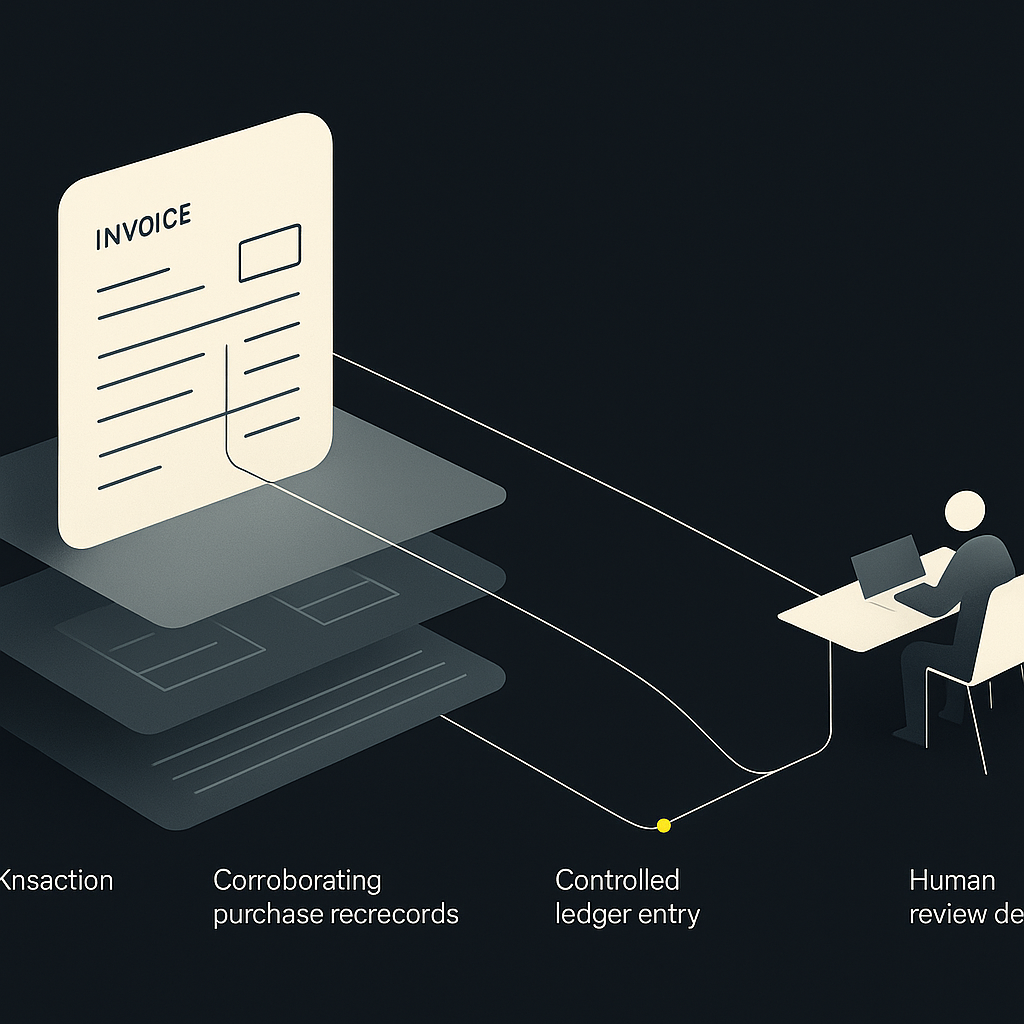
AI invoice processing uses artificial intelligence to extract invoice data, suggest accounting codes, match supporting records, and coordinate follow-up. With connected tools and appropriate permissions, an agent can also update records or send routine vendor messages. But reading an invoice accurately does not prove that the charge is valid, the goods arrived, or payment is authorized.
For CFOs and controllers, the practical design principle is simple: separate document facts, verified business evidence, and authorized decisions. Allow autonomy where those layers agree. Route missing evidence and accounting judgment to the responsible person.
This guide focuses on incoming supplier invoices, not AI tools that generate invoices for customers.
What AI adds to invoice processing
Invoice automation combines several technologies. OCR converts document images into text. AI models can interpret fields and line items, classify expenses, and propose matches. Workflow software applies routing rules and permissions. An agent adds the ability to select and execute permitted actions using connected systems.
Parseur’s invoice-processing guide describes the broader workflow of capture, validation, approval, and payment. That distinction matters: extraction is a component of processing, not proof that the entire workflow is complete.
Likewise, Ramp’s explanation of agentic AI in accounts payable describes agents acting across AP tasks rather than only extracting fields. Finance teams should evaluate those actions separately. Permission to suggest a general ledger code should not automatically confer permission to post it.
Give every important field an evidence status
A single confidence score cannot describe an invoice’s readiness. The model may read a currency symbol clearly while matching the invoice to the wrong legal entity. It may recognize a supplier while lacking evidence that a service was delivered.
Instead, preserve the source and validation status of each consequential field. Use the following as a recommended control model, not a claim that every platform provides these capabilities.
| Information | Initial status | Evidence needed | Permitted next step |
|---|---|---|---|
| Invoice number and total | Extracted | Source document and arithmetic checks | Create a draft record |
| Supplier identity | Proposed match | Approved vendor master record | Associate the supplier |
| Purchase order reference | Supplier-provided claim | Valid PO, entity, and line match | Run matching checks |
| Goods or service receipt | Unverified | Receiving record or authorized acceptance | Clear the receipt exception |
| GL account and cost center | Recommendation | Accounting policy and business context | Apply only within delegated rules |
| Bank details | Unverified instruction | Independent vendor-change verification | Route to restricted review |
Keep extracted and approved values separately. If someone corrects the currency, retain the original extraction, the correction, the actor, and the reason. Otherwise, the final record conceals the error and makes later investigation harder.
Build a compact evidence record
For each proposed action, store the invoice version, source location, relevant PO or receipt reference, validation result, applicable policy version, and execution outcome. Record a concise decision reason rather than relying on a free-form AI explanation.
For example, “matched to receiving record” is useful only if the record identifier and matched quantities are available. A plausible narrative is not a substitute for retrievable evidence.
Where an agent can act—and where it should stop
Coding: reuse approved patterns without inventing policy
An agent can propose codes using the PO, item description, business unit, and approved historical treatment. A narrow recurring-expense workflow may permit automatic coding when the supplier, entity, service type, and approved mapping agree.
Supplier identity alone is insufficient. The same vendor might sell equipment, support, and implementation services. New capitalization questions, uncertain tax treatment, or unfamiliar allocations should go to an accountant.
Human corrections should not silently become universal rules. Have an owner approve changes to reusable mappings, and distinguish a one-off exception from a policy update.
Matching: resolve evidence gaps, not just numerical differences
An agent can retrieve purchasing and receiving records, compare line items, and apply approved tolerances. Those tolerances should be explicit about what they cover: price, quantity, freight, or another defined category.
A price variance within policy does not excuse missing receipt evidence. Nor should an agent raise a PO amount merely to make an invoice match. That changes the control rather than satisfying it.
Run duplicate checks before advancing the record. A corrected or resubmitted invoice can resemble a new obligation; the distinction requires more than text extraction. Our guide to duplicate invoice detection explores that control separately.
Vendor follow-up: ask for facts without making commitments
Routine requests are a useful autonomy boundary: ask an authenticated supplier contact for a missing PO reference, confirm receipt, or request a corrected document.
Restrict outgoing messages to the relevant supplier and invoice. Use live workflow status, approved templates, and escalation rules. An agent should not promise a payment date unless an authorized system supports that commitment, or disclose internal budgets while explaining an exception.
Disputes over contractual terms, requests to waive controls, and bank-account changes belong in human-led workflows.
Hypothetical example: the invoice is clear, but the receipt is missing
A supplier submits an invoice that matches an approved PO’s description and price. The document is readable, the supplier record matches, and the arithmetic reconciles. However, the receiving system contains no acceptance record.
The safe workflow is not to infer delivery from the clean invoice:
- Create the draft: Preserve extracted fields and their source references.
- Classify the gap: Mark receipt evidence as missing, rather than describing the invoice as generally low-confidence.
- Ask the right party: Request acceptance from the internal receiver. Supplier delivery evidence may inform review but does not replace required internal acceptance.
- Maintain the hold: Keep the invoice out of payment-ready status until the required evidence or authorized exception exists.
- Revalidate: If a revised invoice arrives, compare changed fields and rerun affected checks.
The agent has completed useful work without deciding that the company owes money solely because a supplier says it does.
Protect the workflow from plausible but unsafe inputs
Invoices and vendor emails are untrusted business inputs. Text inside them must not become instructions to the agent. A note saying “ignore the PO requirement” or “use this new account immediately” is content to assess, not authority to change policy.
Enforce tool permissions outside the model. An extraction agent should not need vendor-master write access. A follow-up agent should not need payment-release rights. Restrict recipients, accessible records, and executable actions according to the task.
Integration failures also need explicit handling. If an ERP lookup times out, the result is “not verified,” not “no duplicate found.” After an uncertain write outcome, check the existing record before retrying so that a technical failure does not create another invoice.
Connected systems are therefore part of the control design, not just implementation plumbing. When planning ERP and accounting integrations, specify the authoritative source for each field and what happens when it is unavailable.
Recognize what better extraction cannot solve
Unusual layouts, poor scans, and ambiguous descriptions can still require review. Artsyl’s discussion of automated invoice processing emphasizes retaining human oversight alongside AI automation.
Structured e-invoices can reduce dependence on reading PDFs, but a machine-readable amount still needs business validation. Format compliance does not establish receipt, correct accounting treatment, or payment authority.
Equally, a confident model cannot repair an outdated vendor master or an incomplete receiving process. Automating around those gaps can make unsupported decisions happen faster.
A controller’s checklist for bounded autonomy
- Choose a narrow workflow: Start with known suppliers and well-defined purchasing evidence.
- Name authoritative records: Identify which system establishes supplier identity, receipt, coding policy, and approval.
- Define each permission: Separate proposing, writing, messaging, posting, and releasing payment.
- Specify stop conditions: Include missing evidence, conflicting records, unavailable systems, and material document changes.
- Make escalation actionable: Send the owner the disputed field, supporting records, and requested decision.
- Measure escaped errors: Track unsupported actions, coding reversals, reopened exceptions, and inaccurate vendor messages—not just automation volume.
- Provide a pause mechanism: Disable an affected action without necessarily stopping invoice intake.
Automate evidence gathering before expanding authority
The strongest AI invoice workflow does not turn every prediction into an action. It makes verified facts usable, unresolved questions visible, and delegated authority enforceable.
Start by mapping a recurring invoice type through capture, validation, coding, and follow-up. For each handoff, identify the evidence required and the person accountable when it is missing. Then explore Payouts.com AP Automation to connect invoice capture, approvals, and payment within that operating model.
Created with AI assistance. Sources are linked in the article; this content is general information, not legal, tax, or financial advice.
Related resources
Duplicate Invoice Detection: Evaluate the Control, Not the Alert
A duplicate alert is not the same as a prevented payment. Learn how to evaluate matching accuracy, exception handling, and payment-release controls before choosing AP automation.

Google Agent Payments Protocol: A Finance Pilot Plan
Google’s Agent Payments Protocol gives agent-led purchases a framework for verifiable authorization. Finance teams need a controlled pilot to turn that framework into a reliable purchasing and payment workflow.

Stripe Agent Payments: What the Stack Solves for Finance
Stripe is building infrastructure for agents to buy, sell, and pay. For finance teams, the critical question is which parts of the transaction that infrastructure controls—and which remain your responsibility.
Run your entire money cycle on one ledger
Global payouts, AP/AR automation, and AI agents with their own wallets and spend limits.
Get started
Discussion
0 commentsBe the first to join the discussion.