

Azure AI Invoice Processing: What Finance Must Build Around It
Azure can turn supplier invoices into structured data. The buying decision is whether your team can own the validation, exceptions, and ERP workflows that turn that data into approved payables.
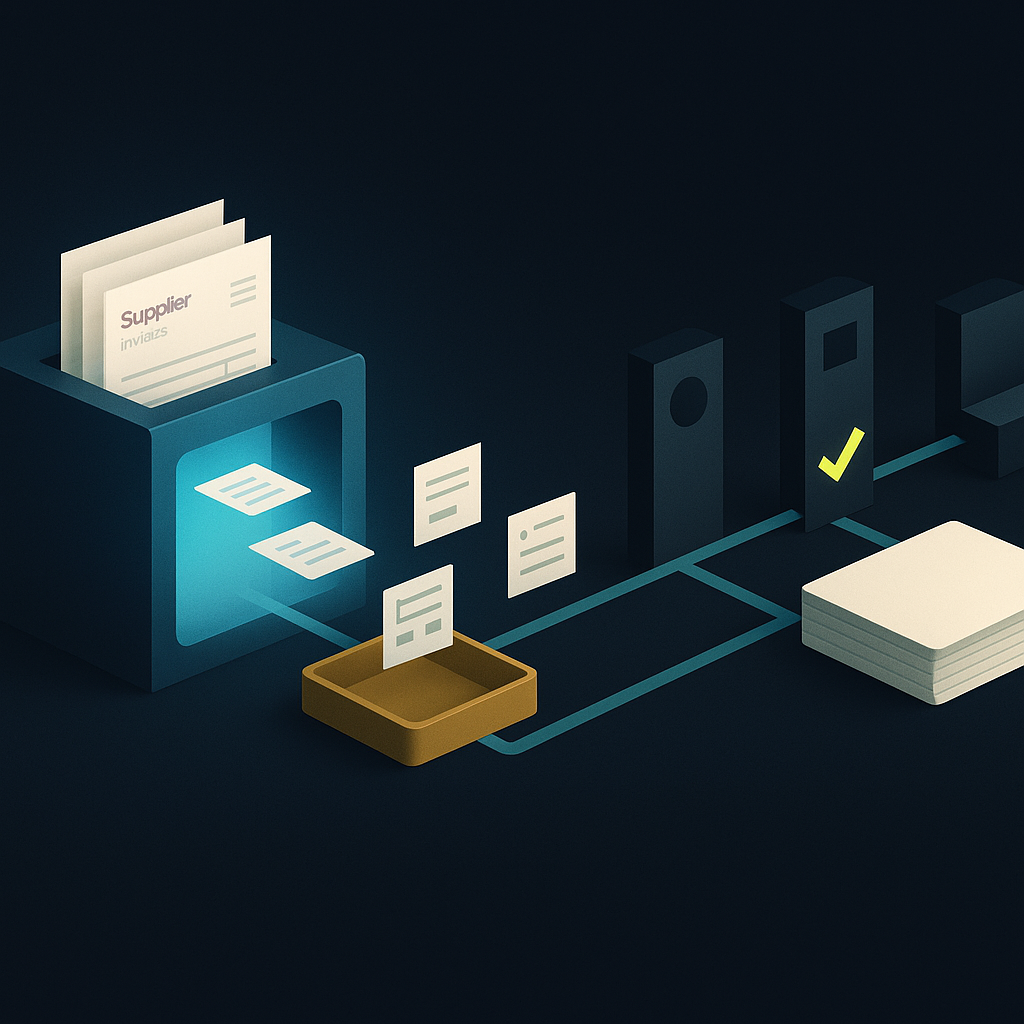
Azure AI invoice processing uses Azure AI Document Intelligence to extract structured fields and line items from invoice PDFs and images. Its prebuilt invoice model can reduce manual entry, but the extraction service alone does not provide a complete accounts payable operation. Supplier validation, matching, approvals, ERP posting, and payment controls require surrounding applications and workflows.
For a mid-market finance team, the decisive question is not simply whether Azure can read an invoice. It is whether your organization should build and maintain the operational layer around that reading capability—or buy that layer as part of an AP platform.
What Azure provides out of the box
Azure AI Document Intelligence, formerly Azure Form Recognizer, offers prebuilt and custom document-processing models. Microsoft's Document Intelligence model overview describes the prebuilt invoice model and its support for extracting invoice information, including customer details, due dates, amounts, and line items.
The prebuilt-invoice model is the logical starting point for a pilot. It provides a Microsoft-defined field schema rather than requiring your developers to design an extraction model from scratch. Typed outputs help downstream systems handle dates and monetary values consistently.
However, a correctly typed field is not necessarily a correct business fact. A date can be parsed successfully but belong to the wrong field. An accurately extracted supplier name may not identify the correct vendor record or legal entity.
Custom models are an option for documents that prebuilt models do not handle adequately. Use them when testing reveals a repeatable extraction problem—not as a default response to missing purchase orders, inaccurate vendor records, or unclear approval policies.
Define the boundary between extraction and AP automation
An Azure-based implementation can use Logic Apps or Power Automate to coordinate intake and downstream actions. Those orchestration tools still need business rules, access permissions, exception handling, and integration logic.
The following responsibility map is a proposed operating design, not a list of capabilities automatically included with the invoice model.
| Stage | Azure extraction contribution | What must surround it | Suggested accountable owner |
|---|---|---|---|
| Invoice intake | Analyzes submitted documents | Mailbox, attachment, and intake controls | AP operations |
| Field capture | Returns invoice fields and line items | Field checks and correction interface | AP systems |
| Supplier identification | Extracts supplier information | Vendor-master and entity resolution | Master-data team |
| Invoice matching | Supplies extracted values | PO, receipt, tax, and tolerance rules | AP and procurement |
| Approval | No spending authority | Approval matrix and delegation controls | Controller |
| ERP posting | Supplies data for integration | Posting logic, retries, and acknowledgments | ERP team |
| Payment release | No payment authorization | Verified payee details and release controls | Treasury |
This boundary matters when comparing Azure with accounts payable automation. An extraction API and an invoice-to-payment application are different purchasing units. Compare the complete operating scope rather than their headline prices.
Design the Microsoft workflow around durable states
Capture documents without losing their identity
Assign an intake identifier when an invoice arrives. Retain the original document, source channel, receipt timestamp, and processing status. Send the document for analysis and associate the returned result with that identifier.
Keep technical retry detection separate from business duplicate detection. Resubmitting the same attachment after a timeout should not create a second work item. Conversely, an invoice resent as a different scan may still represent the same payable. The latter requires duplicate invoice controls beyond file matching.
Validate before routing for approval
Use the extracted data to resolve the supplier and buying entity against approved records. Then check required fields, totals, currency, purchase-order references, and receipt information where applicable.
Separate extraction exceptions from business exceptions. An unreadable invoice number needs document review; an invoice that exceeds the remaining PO balance needs a purchasing decision. Combining both in a generic error queue obscures ownership and slows resolution.
Confidence scores can help prioritize review, but they should not grant spending authority. Set review rules by field risk and observed performance on your documents. A high-confidence amount still needs matching and authorization.
Make ERP posting safe to retry
Use explicit states such as received, extracted, validated, approved, posting pending, and posted. Record an ERP document identifier only after confirming acceptance.
A timeout is not proof that posting failed. Before retrying, check whether the ERP already created the payable. Where supported, use an idempotency key—a stable request identifier that prevents repeated submissions from creating duplicate records. Otherwise, build a reliable lookup and reconciliation step.
Preserve original extraction results separately from approved corrections. The audit record should show the source document, changes, approver decisions, and posting outcome—not just the final values.
If you use Dynamics 365, evaluate its application layer first
Dynamics 365 Finance users should distinguish a custom Document Intelligence implementation from Microsoft's packaged invoice-capture approach. Microsoft's invoice capture announcement describes AI-assisted capture within the broader AP process, including matching and exception handling.
That announcement is not evidence that every feature is available in your environment or license. Confirm current prerequisites, supported scenarios, configuration responsibilities, and the boundaries between capture and Finance workflows before commissioning a parallel build.
For other ERPs, test the actual posting interface early. Authentication may be straightforward while tax codes, dimensions, attachments, credit notes, or closed-period behavior become the real implementation constraints.
Where extraction must not become authority
Bank details deserve a separate control path. A Microsoft Q&A response about invoice bank-account recognition acknowledges that bank account numbers may not always be identified successfully. This is a support discussion, not a comprehensive accuracy benchmark.
Even perfect recognition would not establish that the account belongs to the approved supplier. Never let an invoice update payment instructions automatically. Treat new or changed bank details as a vendor-master change requiring independent verification.
Other important boundaries include:
- Tax: extracting a tax amount does not establish correct tax treatment.
- Language and layout: supported documents still need testing against your actual supplier mix.
- Access: permission to analyze an invoice should not also permit vendor changes or payment release.
- Retention and residency: verify the selected deployment, storage, access, and retention arrangements against your obligations.
Cost the workflow, not just the pages
Document Intelligence uses page-based billing, but extraction charges are only one component of an Azure implementation. Obtain a current quote for your region and configuration rather than treating an online unit price as an all-in invoice-processing cost.
Your business case should include:
- Extraction usage, including multipage documents and reprocessing.
- Workflow execution, storage, monitoring, and applicable connector or application licensing.
- Implementation and ongoing ERP integration maintenance.
- Exception-review labor and support ownership.
- Regression testing when models, rules, or ERP interfaces change.
Measure cost per successfully posted invoice alongside total AP cost through payment and reconciliation. Keep those denominators distinct. A cheaper extraction step can coexist with an expensive exception queue.
Also account for switching effort. An Azure build becomes harder to replace when extraction responses, workflow logic, identity, and exception screens are tightly coupled. Keep an internal invoice schema between the model output and the ERP to reduce that dependency.
A practical pilot checklist
Make the pilot an operational acceptance test, not an OCR demonstration.
- Select representative documents. Include different suppliers, languages, scans, credit notes, multipage invoices, and PO and non-PO scenarios.
- Establish expected outcomes. Define correct fields, required validations, exception owners, and acceptable posting behavior before reviewing results.
- Test failure recovery. Interrupt extraction and posting, resend attachments, and submit business duplicates. Verify that recovery does not create another payable.
- Exercise financial controls. Include missing receipts, ambiguous suppliers, changed bank instructions, and unauthorized approvers.
- Measure downstream work. Track field corrections, exception reasons, review effort, and successful ERP postings—not just extraction completion.
- Assign permanent ownership. Name who maintains workflows, monitors failures, approves rule changes, and supports AP during close.
Use the same documents and acceptance conditions when evaluating packaged software. The broader AP platform acceptance checklist can help structure that comparison.
Choose Azure when you can own what surrounds it
Azure AI invoice processing is a credible foundation when your organization needs tailored extraction and has the engineering and finance-system ownership to maintain the surrounding workflow. A packaged AP application deserves stronger consideration when the urgent problem is email approvals, exception handling, and disconnected payment execution.
The next step is to map responsibility from invoice receipt to ERP posting and payment. Then run the same exception-heavy pilot against each option. Choose the operating model that resolves the work—not merely the model that reads the document.
Created with AI assistance. Sources are linked in the article; this content is general information, not legal, tax, or financial advice.
Discussion
4 commentsRelated resources
Duplicate Invoice Detection: Evaluate the Control, Not the Alert
A duplicate alert is not the same as a prevented payment. Learn how to evaluate matching accuracy, exception handling, and payment-release controls before choosing AP automation.
Accounts Payable Automation Platform: A Buyer’s Acceptance Checklist
The right AP platform should reduce work across the invoice-to-payment cycle—not move it into another queue. Use this acceptance checklist to turn vendor demonstrations into a defensible buying decision.
Payables Automation: Build a Defensible Business Case
The strongest payables automation business case measures work eliminated—not just invoices captured. Here’s how to compare options without overstating savings.
Run your entire money cycle on one ledger
Global payouts, AP/AR automation, and AI agents with their own wallets and spend limits.
Get started
One thing missing here is how you handle invoices that reference multiple POs or split across cost centers. The prebuilt model extracts line items fine but matching logic gets complicated fast when one invoice line needs to hit three different GL accounts with different approvers. Did anyone here solve this without custom code?
The durable state map in the workflow section is exactly what we learned the hard way. We built our first Azure DI pilot without explicit state tracking and ended up with invoices stuck in limbo after ERP timeouts. Nobody could tell if a payable existed or not. The idempotency advice should be in bold—most ERP APIs don't give you this for free and you will post duplicates if you rely on retry logic alone.
Good framing on the build vs buy boundary. We evaluated Azure Document Intelligence last quarter and the extraction accuracy was solid, but when we scoped out the approval matrix, vendor master resolution, and exception UI our internal estimate went from two sprints to six months of eng time plus ongoing maintenance. Ended up being cheaper to pay for a platform that already solved those problems.
Same experience. The extraction piece was fast to demo but the vendor resolution alone took us weeks—our vendor master had duplicates, name variations, address mismatches. That cleanup became the real project before we could even touch approval workflows.