

FXC Intelligence Cross-Border Payments: Using the Research
FXC Intelligence helps explain the cross-border payments market. For finance teams, the practical value comes from matching its research to the payments they actually make—and knowing where market intelligence stops.

FXC Intelligence is a specialist cross-border payments data and research firm, not a payout execution platform. Its research helps banks, payment companies, investors, and finance teams understand market size, pricing, competitive positioning, and payment trends. For businesses paying vendors, contractors, or sellers internationally, its most useful role is to provide external context for internal payment decisions.
The distinction matters: market intelligence can tell you what to investigate; it cannot establish what your business will pay or when a particular recipient will receive funds. Using FXC Intelligence cross-border payments research well means connecting the right dataset to a specific question, then validating the answer against your own quotes, contracts, and transaction records.
What FXC Intelligence provides
FXC Intelligence describes its offering as cross-border payments data and intelligence, alongside payment card industry data. Its coverage spans business and consumer payments rather than a single payout use case.
That breadth creates several useful research entry points:
- Market sizing: Understand payment flows and the relative scale of countries, corridors, and customer segments.
- Pricing intelligence: Investigate FX margins and cross-border fees across relevant markets and use cases.
- Provider research: Identify companies and understand their role in the competitive landscape.
- Industry analysis: Follow developments such as regional expansion, infrastructure changes, and emerging settlement models.
Public reports and commercial datasets are not interchangeable. Before building a business case around either, confirm the available fields, coverage, observation dates, access terms, and permitted uses. A public summary does not establish that a particular corridor-level extract is available to you.
Match the research to the decision
The following framework is an editorial guide to using research, not a rating of FXC Intelligence products.
| Research input | Useful finance question | Evidence still needed | Interpretation limit |
|---|---|---|---|
| Market flow estimates | Where should we investigate demand? | Own recipient and invoice mix | Market size is not payout demand |
| Pricing observations | Which costs deserve review? | Matched quotes and contracts | Observed price is not your price |
| Revenue and take rates | Where may pricing pressure exist? | Segment and corridor definitions | Provider yield is not buyer cost |
| Provider landscape | Who belongs on a research shortlist? | Eligibility and service validation | Inclusion is not certification |
| Rail and technology analysis | Which assumptions should we test? | End-to-end payout evidence | Rail speed is not recipient availability |
Build a comparable benchmark before judging price
FXC Intelligence's market sizing data offering describes country- and corridor-level flows across consumer and business segments, together with revenue and take-rate data. This granularity is important because a global average can obscure the economics of the payments your business actually makes.
For a finance team, however, geography is only the starting point. Two payments to the same country can have different costs because they use different funding currencies, payout methods, customer agreements, or payment amounts.
Create a benchmark specification
Document the following before comparing an external observation with an internal transaction:
- Direction and currencies: Sending country, receiving country, funding currency, and recipient currency.
- Customer and recipient type: Consumer or business sender; individual or business beneficiary.
- Amount and pricing basis: Payment size, contractual volume tier, and whether the quote fixes sender debit or recipient credit.
- Funding and delivery method: Bank funding, wallet balance, or another supported method; bank account or other payout endpoint.
- Observation timing: Quote timestamp, FX reference timestamp, and quote validity.
- Included charges: Transfer fees, FX markup, possible deductions, and separately billed platform charges.
If those dimensions cannot be matched, label the comparison directional, not evidence of overcharging or achievable savings. In particular, consumer remittance pricing should not be presented as a directly available corporate payout rate.
Compare like-for-like economic outcomes
For an invoice that must arrive in full, compare total sender cost for the same net recipient amount. For a fixed payout budget, compare the net amount received for the same total sender debit. Mixing those approaches can make a deducted fee disappear from the analysis.
Keep operational costs separate from quoted payment costs. Exception handling, reconciliation effort, and the cost of maintaining prefunded balances matter, but they are not necessarily included in an external pricing observation. The cross-border payment fee review framework provides a practical companion for examining those cost components.
Do not translate market take rates into your savings target
FXC Intelligence's March 2026 release reported that retail cross-border payment take rates declined across segments between 2022 and 2025, while payment flows grew faster than the revenue pool. Its analysis of market growth and tightening take rates emphasizes the importance of corridor and segment mix.
That is useful negotiation context, but it does not prove that your provider's margin fell—or that your contract should fall by the same amount. A market take rate reflects revenue relative to payment flows within the research scope. Your effective cost reflects your own transaction mix and commercial terms.
To distinguish repricing from a change in payment mix, compare costs within matched groups of payments before calculating a blended result. If more of your volume shifts toward inexpensive corridors, the average cost can improve even when no provider changes its rates.
Similarly, if a proposal relies on holding funds locally to improve conversion timing, evaluate that treasury change separately. Multi-currency accounts can support collecting and holding funds, but retained balances introduce liquidity allocation decisions that a transfer-price benchmark alone cannot resolve.
Use the Cross-Border Payments 100 as a landscape, not a recommendation
The FXC Intelligence Cross-Border Payments 100 identifies significant companies across the industry. Its selection criteria consider factors such as significance within a market or segment, the importance of cross-border payments to the business, and growth.
Those criteria support market discovery. They do not establish that each company can serve your legal entity, recipient countries, payment purposes, or operational requirements. The list spans different business models; companies on it are not automatically direct substitutes.
Use inclusion to generate questions rather than award procurement points. Ask which services the company actually provides, which customer segments it serves, and whether it controls the recipient-facing payment leg or depends on another institution. Regulatory suitability, contractual responsibilities, and operational performance require separate diligence.
A hypothetical example: turning a benchmark gap into a test
Hypothetical scenario: A business pays contractors in several countries. External pricing research suggests one corridor may be expensive relative to comparable observations. Finance wants to use the apparent gap as a savings forecast.
Instead of immediately changing providers, the team separates payments by amount, recipient currency, and payout method. It discovers that some internal transactions include a conversion before the provider receives funds, while the external comparison starts with funds already available in the sending currency.
The appropriate next step is to obtain comparable end-to-end quotes—not to subtract the published benchmark from historical spend. Finance then checks the net recipient amount, funding requirements, quote validity, and treatment of failed payments.
The research has still delivered value: it identified a question worth investigating. But the resulting business case should use validated economics and explicitly exclude untested payment groups.
Checklist: make research usable in a finance decision
- Define the question. Separate market expansion, provider discovery, price negotiation, and treasury design.
- Record the source. Capture publication date, data period, segment definitions, and whether figures are estimates or observations.
- Check coverage. Confirm direction, currencies, payment amount, customer type, and delivery method.
- Label comparability. Mark each comparison as matched, directional, or unsuitable.
- Request missing evidence. Obtain methodology details, executable quotes, or contractual clarification before asserting savings.
- Validate the full outcome. Check sender debit, recipient credit, funding needs, and actual payment completion.
- Assign a refresh trigger. Revisit the analysis when pricing, payment mix, funding arrangements, or source methodology changes.
Turn market intelligence into controlled execution
FXC Intelligence research is most useful as an external reference for better questions—not as a substitute for transaction evidence. Keep market estimates, observed pricing, provider eligibility, and your own measured outcomes distinct.
Start with a material corridor, write the benchmark specification, and validate the apparent opportunity. Then assess how Payouts.com payout automation fits the execution workflow. The goal is not simply a more persuasive market slide; it is a payment decision finance can explain, implement, and reconcile.
Created with AI assistance. Sources are linked in the article; this content is general information, not legal, tax, or financial advice.
Related resources

How to Reduce Cross Border Payment Fees: A Finance Playbook
Lower transfer fees do not always mean cheaper payouts. Learn how to negotiate, operationalize, and verify savings across your international payment program.
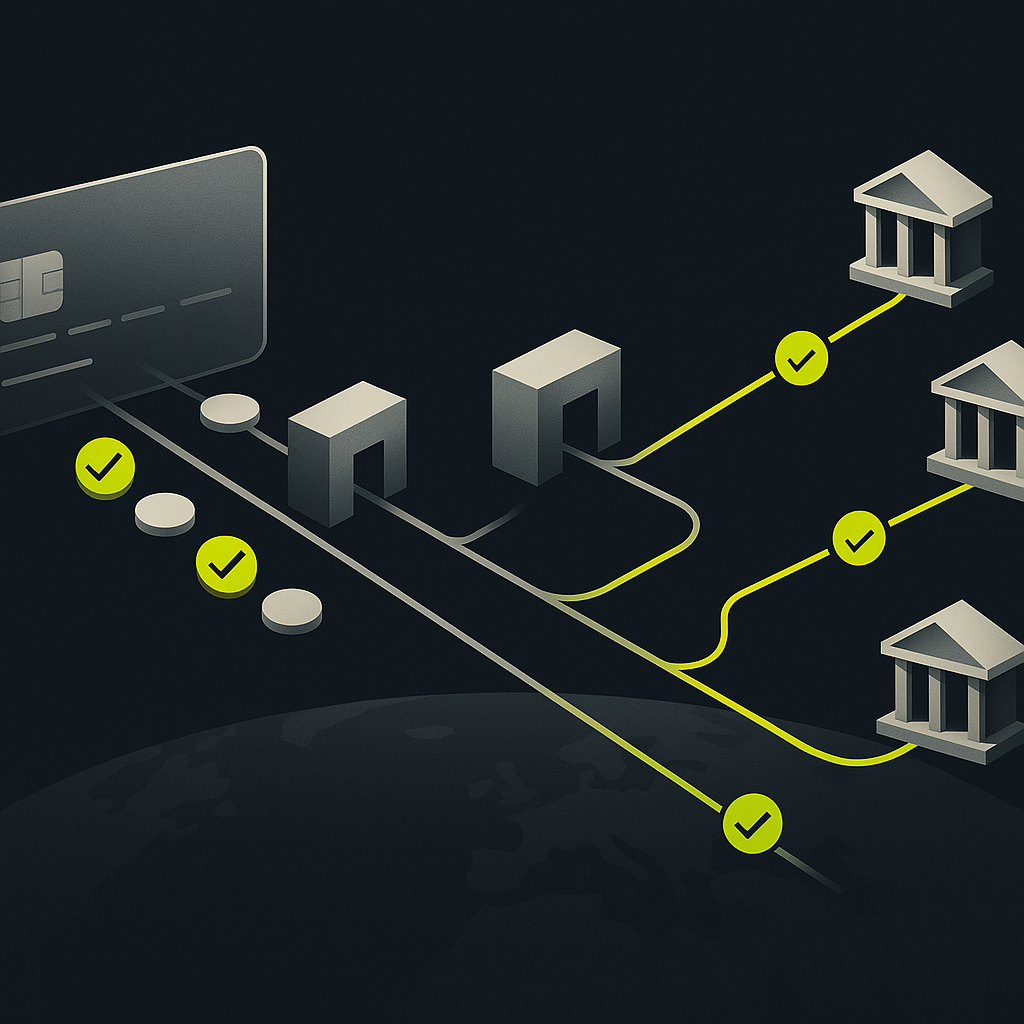
Credit Card Affiliate Payout: From Issuer Approval to Partner Cash
A card approval is not necessarily a payable commission—or money ready to send. Finance teams need to connect issuer validation, contractual release rules, and cross-border delivery without losing the audit trail.

BRICS Cross Border Payments Initiative: A Finance Guide
The BRICS payments initiative is a direction for financial cooperation, not proof of a universally available payout network. Here is how finance teams can separate policy ambitions from usable payment capabilities.
Run your entire money cycle on one ledger
Global payouts, AP/AR automation, and AI agents with their own wallets and spend limits.
Get started
Discussion
0 commentsBe the first to join the discussion.