

Payroll Tax Reporting: Connect Global Payments to Compliance
Payroll tax reporting is not complete when salaries leave the bank. Finance teams need a traceable connection between taxable earnings, tax liabilities, filings, and settled payments across jurisdictions.
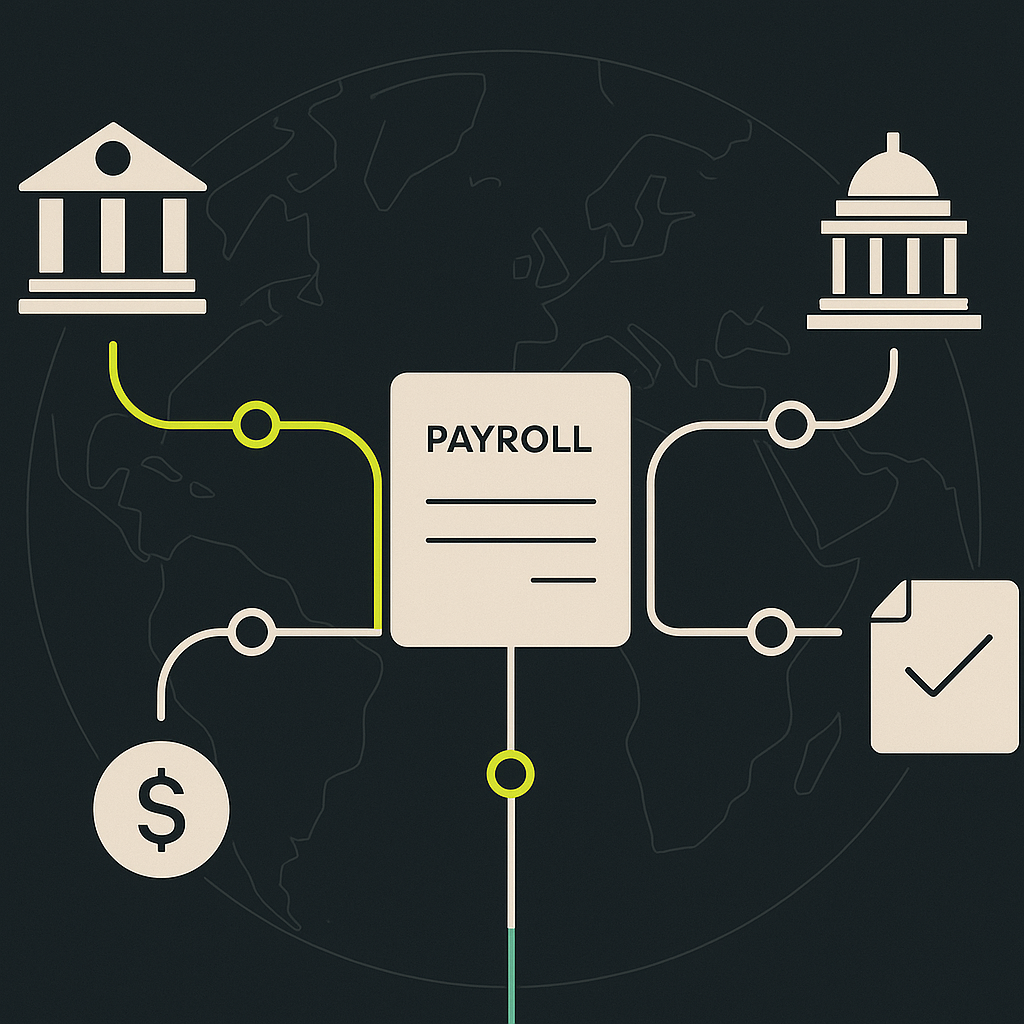
Payroll tax reporting is the process of reporting employee compensation, taxes withheld, and employer employment-tax liabilities to the relevant authorities. It is separate from depositing those taxes and paying employees. A successful salary transfer does not prove that a return was accepted or that a tax liability was paid correctly.
For finance teams managing international recipients, the challenge is connecting these separate obligations without confusing employee payroll with contractor or supplier payments. The strongest control is a traceable chain from approved earnings to the payroll register, tax return, tax payment, and employee settlement.
This guide uses U.S. federal reporting as a concrete baseline, then explains the payment and reconciliation controls needed across borders. Local payroll rules still require jurisdiction-specific validation.
Separate payroll reporting from payment execution
A global payment operation may pay employees, contractors, vendors, and sellers through shared infrastructure. That does not make their tax treatment interchangeable.
Employee payroll generally involves wage calculations, withholding, employer contributions, and employment-tax reporting. Contractor payments can involve information reporting or withholding under separate rules. Worker classification must be resolved under applicable law before the payment workflow is selected; a contractor label in the recipient database is not a legal determination.
Assign accountable owners to each obligation:
- Payroll: calculate earnings, deductions, taxable bases, and liabilities.
- Tax or local payroll specialists: determine reporting requirements, validate returns, and manage corrections.
- Treasury: fund employee payments and tax deposits in the required currencies.
- Payment operations: release approved transfers, monitor settlement, and resolve returns.
- Controllership: reconcile payroll, filings, cash, and the general ledger.
One provider may perform several tasks, but the contract and operating procedure should specify which tasks it actually handles. Moving money, calculating payroll, and filing returns are different services.
Know the U.S. reporting baseline
The IRS distinguishes employment-tax deposits from employment-tax reporting. Employers generally report compensation and employment taxes through the applicable returns while meeting separate deposit obligations.
| Form or obligation | Primary purpose | Operational control |
|---|---|---|
| Form 941 | Quarterly federal withholding and Social Security/Medicare reporting | Reconcile liabilities, deposits, and adjustments |
| Form 940 | Annual federal unemployment tax reporting | Track FUTA separately from other liabilities |
| Form W-2 | Annual employee wage and tax reporting | Reconcile employee totals to payroll records |
| Forms 943 and 944 | Alternative returns for applicable employers | Confirm eligibility or required filing status |
| Tax deposits | Payment of employment-tax liabilities | Match payment to taxpayer and tax period |
| State and local reporting | Jurisdiction-specific withholding and other obligations | Maintain separate calendars and acknowledgments |
Do not use filing deadlines as funding deadlines
According to the IRS Instructions for Form 941, quarterly filing deadlines generally fall on April 30, July 31, October 31, and January 31, with applicable weekend and holiday adjustments. Deposit obligations can arise much earlier.
For 2026, the Form 941 lookback period runs from July 1, 2024, through June 30, 2025. Reported taxes exceeding $50,000 during that period generally put an employer on the semiweekly deposit schedule. Other rules, including accelerated deposit requirements, can affect the actual deadline. Maintain a deposit calendar separately from the filing calendar.
Treat legislative changes as payroll-data changes
For U.S. payroll, the qualified tip and overtime deductions introduced under the One Big Beautiful Bill Act do not simply make those earnings exempt from payroll taxes. Warren Averett's explanation of the reporting changes distinguishes employee income-tax deductions from continuing employer withholding and payroll-tax obligations.
The operational lesson is to retain earning-code detail rather than only gross pay. Validate reporting fields against final instructions for the relevant tax year, and do not build production mappings solely from draft forms.
Build a country obligation record before releasing payroll
A recipient's bank country does not, by itself, determine where payroll taxes belong. Employment arrangements, work location, residency, and applicable cross-border rules may matter. International assignments can require coordinated reporting in more than one jurisdiction.
Maintain an obligation record for each employing entity and relevant jurisdiction:
- Registration: legal employer, taxpayer identifiers, payroll registrations, and authorized filing party.
- Worker data: employee identifier, applicable local tax identifiers, work location, and effective-dated changes.
- Calculation rules: earning-code treatment, taxable benefits, deductions, and employer contributions.
- Reporting requirements: forms or submission schemas, reporting currency, deadlines, and acknowledgment format.
- Payment requirements: authority bank details, permitted payment methods, tax references, and funding cutoffs.
- Evidence controls: retention requirements, access permissions, correction procedures, and escalation owner.
Have a qualified local specialist validate this record. Payment onboarding checks do not replace payroll registration or employment-tax analysis.
Keep payroll FX separate from treasury FX
Cross-border payroll can involve different currencies for the employment obligation, statutory reporting, and funding. Those amounts should not be collapsed into a single converted total.
Store the original payroll amount, reporting-currency amount, conversion methodology, rate source, rate date, and actual funding conversion separately. Apply the reporting conversion required by the relevant jurisdiction; do not assume the treasury execution rate is acceptable for tax reporting.
Multi-currency accounts can support holding funds ahead of payment runs, but prefunding is a liquidity decision, not a tax calculation. Exchange differences and payment charges should remain visible rather than being silently netted against wages or tax liabilities.
Rail selection also affects delivery evidence. Local transfers and correspondent-bank payments can differ in cutoff times, fee handling, and status visibility. A documented local-rail versus SWIFT routing policy should account for those differences while preserving the approved payroll obligation.
Reconcile obligations, not just bank totals
A bank debit proves that cash left an account. It does not necessarily prove employee receipt, correct allocation by a tax authority, or acceptance of a return.
Create a reconciliation record linking the legal entity, payroll run, employee or authority, tax period, liability type, currency, and source transaction. Preserve distinct evidence for:
- Approved payroll: the calculation version and authorized register.
- Reported liability: the filed return and acceptance or rejection response.
- Tax payment: the payment reference and authority receipt or account posting where available.
- Employee payment: the transfer status, settlement evidence, and any return.
- Ledger posting: wages, deductions, employer costs, liabilities, fees, and exchange differences.
Reconcile by tax type and period before aggregating. Different statutory wage bases and timing adjustments may require a documented bridge rather than a simple equality check.
When connecting payroll and accounting through financial-system integrations, require stable identifiers and version history. A replacement file should not erase the relationship between the original liability and its correction.
Hypothetical example: a returned salary payment
A U.S. employer with an international workforce approves payroll, submits its applicable reporting, and releases employee payments. One salary transfer returns because the beneficiary account is closed.
Operations should not automatically reverse taxable wages or reduce the next tax deposit. Whether a payroll adjustment is required depends on the facts and applicable rules; a transfer failure alone does not answer that question.
Instead, record the return against the original payment, restore the outstanding employee payable as appropriate, validate replacement bank details, and link the reissued transfer to the same obligation. Payroll or tax specialists decide whether reporting needs correction. This prevents a payment retry from becoming a duplicate expense or an unsupported tax adjustment.
A payroll tax reporting control checklist
- Before calculation: confirm classification, employing entity, work locations, and effective-dated tax data.
- Before approval: review earning-code mappings, unusual adjustments, and gross-to-net variances.
- Before funding: reserve liquidity separately for net wages, employee withholding, and employer liabilities.
- Before release: validate beneficiary details, authority references, currencies, cutoffs, and approvals.
- After submission: capture filing acknowledgments and investigate rejections, not just transmission failures.
- After payment: reconcile settlements, returns, tax receipts, fees, and FX differences.
- Before close: document unresolved balances, correction owners, and deadlines.
Connect the payment layer without confusing its role
Reliable payroll tax reporting depends on keeping calculations, filings, deposits, and settlement distinct while making their relationships auditable. Faster transfers cannot repair incorrect tax data, and an accepted return cannot prove employees received their wages.
Start by tracing one payroll run from approved earnings through authority acknowledgment and employee settlement. Identify every point where the reference, amount, currency, or owner changes.
Payouts.com brings global money movement, treasury, and financial automation into one operating system. Explore payout automation for the payment-execution layer, while explicitly assigning payroll calculation and statutory filing responsibilities to the appropriate systems and specialists.
Created with AI assistance. Sources are linked in the article; this content is general information, not legal, tax, or financial advice.
Discussion
3 commentsRelated resources

Local Payment Rails vs SWIFT: Build a Corridor Routing Policy
The right payout route depends on the recipient’s currency, bank reachability, funding, and payment purpose—not just the transfer fee. Here is how finance teams can turn that decision into a repeatable corridor routing policy.

Western Union Cross Border Payments: Fit for Business Payouts?
Western Union’s cash and digital delivery options can address recipient-access needs. Finance teams must separately verify business-use eligibility, total cost, and the controls required for recurring payouts.

OnlyFans Creator Account: Setup, Verification, and Payouts
Opening an OnlyFans creator account is only the first step toward receiving earnings. Understand verification, withdrawal eligibility, bank requirements, and the controls agencies need before treating platform revenue as available cash.
Run your entire money cycle on one ledger
Global payouts, AP/AR automation, and AI agents with their own wallets and spend limits.
Get started
Do you have a recommended approach for the obligation record when you have employees on short-term assignments that create dual reporting requirements? We've got engineers rotating through our Singapore office for 3-6 month stints and the tax treatment gets messy fast.
The point about keeping payroll FX separate from treasury FX is something we learned the hard way. We were collapsing everything into a single converted figure for months and our auditors flagged it during year-end. Now we log the original amount, the statutory reporting conversion, and the actual wire rate in three separate fields.
"A contractor label in the recipient database is not a legal determination" - wish more payment platforms understood this. We've had vendors pitch their tools as solving classification when they're really just adding a dropdown menu.