

Western Union Cross Border Payments: Fit for Business Payouts?
Western Union’s cash and digital delivery options can address recipient-access needs. Finance teams must separately verify business-use eligibility, total cost, and the controls required for recurring payouts.
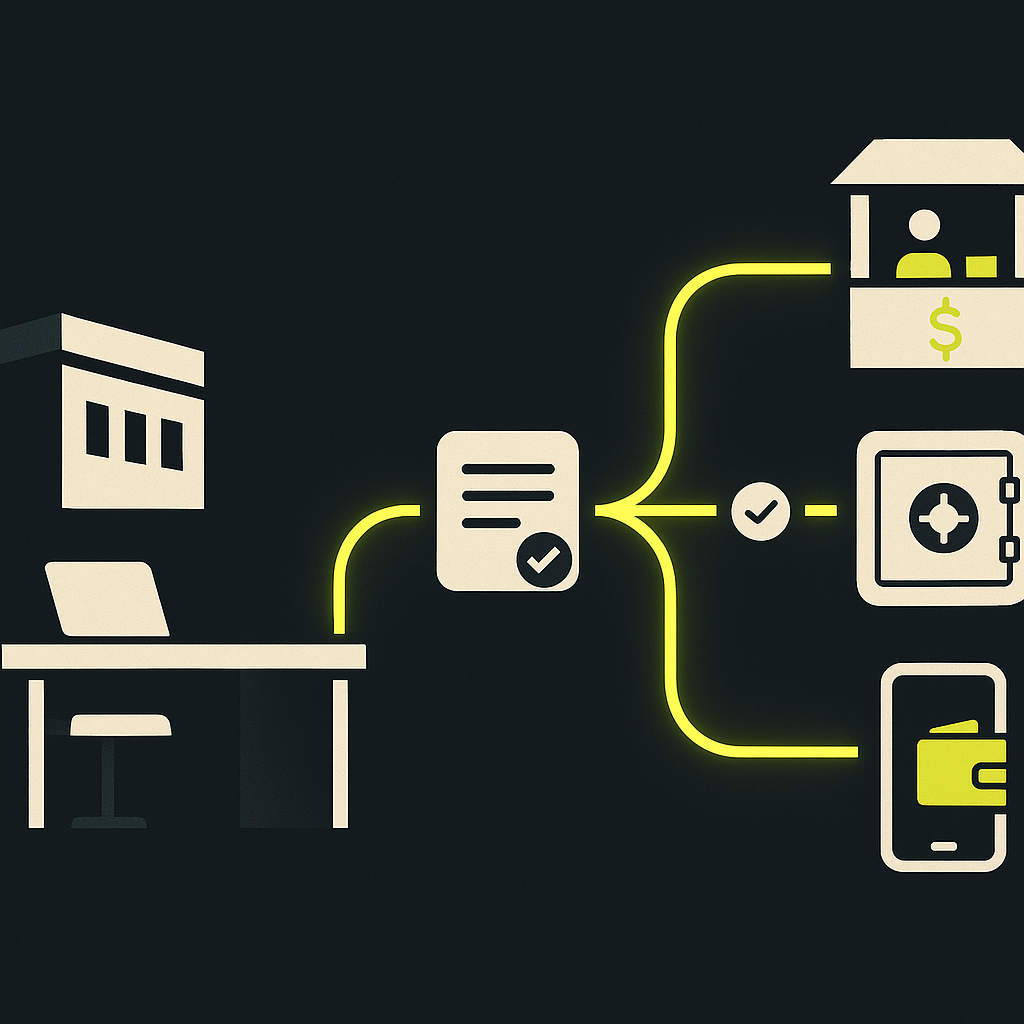
Western Union cross border payments let senders move money internationally through digital and agent channels, with cash pickup, bank-account delivery, or wallet delivery available on supported routes. For companies paying vendors, contractors, or sellers, the key question is not simply whether a recipient can receive money. It is whether the specific service permits the business payment and provides adequate approvals, tracking, and reconciliation.
Treat recipient access and business-payment suitability as separate decisions. Cash pickup may solve a genuine access problem, but it does not by itself establish that a consumer transfer workflow is appropriate for recurring commercial disbursements. For teams paying 100+ recipients internationally, that distinction should come before any price comparison.
What Western Union’s transfer model actually solves
Western Union connects different ways of funding a transfer with different ways of receiving it. Its agent network supports cash-based access, while digital channels support online initiation and tracking. A third-party overview of Western Union’s methods and limits describes these options; availability and requirements still need confirmation for the actual sending market and destination.
A useful distinction is that the initiation channel, funding method, and delivery method are not the same thing. Starting a transaction in an app does not mean the recipient receives a bank deposit. Paying at an agent location does not establish when the recipient can collect the money.
Build your assessment around a complete route: sending entity and country, funding currency and method, recipient country and currency, delivery method, amount, and payment purpose.
| Delivery option | Best for: editorial assessment | Operational check | Completion evidence to request |
|---|---|---|---|
| Cash pickup | Recipients needing physical cash access | Accepted ID, name match, location access | Confirmed collection status |
| Bank-account delivery | Recipients with eligible accounts | Account fields, currency, business-use eligibility | Credit confirmation or documented final status |
| Wallet delivery | Recipients using supported wallets | Wallet eligibility, limits, withdrawal costs | Wallet-credit confirmation |
These are route-assessment categories, not a promise that every method is available in every market. Confirm both sender and recipient eligibility before offering a method to your payees.
Verify the business service before evaluating its features
A familiar brand name is not a product specification. Ask Western Union or the relevant contracting provider to identify the legal entity, product, and terms that would govern your payments. Do not treat historical material about Western Union Business Solutions as proof of features available through today’s retail transfer service.
Get explicit answers to these questions:
- Permitted purpose: Does the service accept your particular vendor, contractor, seller, or other commercial payment?
- Sender identity: Can your company register and fund payments in its own legal name?
- Recipient eligibility: Can it pay individuals, legal entities, or both?
- Operating model: Are bulk submission, APIs, or managed disbursement arrangements available under the proposed agreement?
- Control model: Can payment preparation and release be assigned to different authorized users?
- Records: What transaction, fee, FX, and final-status data can finance export?
These are requirements to verify, not assertions that a particular Western Union product includes or lacks them. If the proposed workflow depends on employees sending company money through personal accounts, pause the evaluation. That arrangement raises ownership, authorization, and recordkeeping questions that a successful test transfer cannot resolve.
Compare the recipient outcome, not just the transfer fee
The cost of a cross-border transfer can include both an explicit fee and the exchange rate applied to the principal. Wise’s explanation of Western Union international fees discusses this distinction. Because Wise is a competitor, use the explanation to structure your comparison—not as a substitute for a live Western Union quote.
Request quotes for the same route, amount, delivery method, and timing. Record:
- The total amount debited from the sender.
- The transfer fee and any separately disclosed funding charges.
- The exchange rate, quote time, and validity period.
- The amount and currency promised to the recipient.
- Any disclosed recipient withdrawal or receiving charges.
- The treatment of fees and currency conversion if the transfer is canceled or returned.
For invoice payments, compare a fixed recipient amount. If the obligation is denominated in the recipient’s currency, ask what sender debit delivers that obligation in full. Comparing equal sending amounts can conceal a short payment.
A mid-market reference rate can help estimate the FX spread, but it is a benchmark—not necessarily an executable rate for your transaction. Capture it at approximately the same time as the quote, and avoid counting the embedded FX spread twice when assessing total cost.
For repeatable quote capture and cost attribution, use the framework in how to reduce cross-border payment fees. For Western Union specifically, preserve the quoted initiation channel as well: do not assume an agent quote and an online quote have identical pricing.
Cash pickup changes the definition of “paid”
A transfer that is ready for collection has reached a different state from one the recipient has collected. Finance should preserve that distinction even if the provider’s interface uses a broad label such as “available.”
Before approving cash pickup, confirm the destination-specific requirements for legal-name matching, accepted identification, transfer-reference presentation, collection deadlines, and location access. A recipient’s preferred name in your vendor record may not match the identification used at the counter.
Keep country requirements method-specific. A bank deposit may require local routing information and an account identifier; a wallet transfer may require a wallet-linked phone number or other identifier. Do not collect every possible field globally. Obtain the current field specification for the selected route and collect sensitive information securely.
Set up a cash-pickup exception record
For each cash payout, retain the payable reference, authorized recipient, transfer reference, promised currency and amount, availability status, collection status, and exception owner. Define how long an uncollected transfer can remain unresolved before operations investigates.
If a recipient reports a collection problem, verify the original transfer’s status before issuing a replacement. An uncollected transfer is not necessarily canceled. Reissuing through another method without closing the first instruction creates duplicate-payment risk.
Provider identity checks also do not replace your own supplier validation, invoice approval, or applicable tax-documentation obligations. Keep payment release subject to your company’s approval policies, including recipient-detail changes.
Separate delivery speed from settlement headlines
Evaluate speed through observable events: instruction accepted, funding confirmed, review cleared, funds available, and recipient credited or cash collected. Ask which event the quoted delivery estimate describes, and what happens if compliance review or recipient-data correction interrupts the transfer.
Western Union’s infrastructure announcements require the same discipline. CoinDesk reported in April 2026 that the company was preparing a stablecoin-based approach to settlement with its agents. The supplied research does not confirm full commercial deployment as of October 2026.
That announcement is not evidence that every customer transfer settles instantly, that recipients can receive stablecoins, or that business customers have access to new payout APIs. SWIFT messaging, partner settlement, and final recipient delivery are separate functions. Faster internal settlement does not eliminate local collection hours or recipient verification.
A practical approval checklist for finance teams
Before putting Western Union into a recurring payout workflow, assemble a route-specific approval record:
- Confirm permission. Document the contracting entity, commercial purpose, permitted recipient type, and corporate funding requirements.
- Validate recipient access. Check the actual bank, wallet, or pickup requirements—not merely destination-country coverage.
- Capture a complete quote. Preserve sender debit, recipient amount, fee, rate, delivery estimate, and quote expiry.
- Verify controls. Demonstrate authorization, duplicate prevention, access restrictions, and secure recipient-data handling.
- Follow the payment to completion. Establish which status proves collection or credit and how that status reaches finance.
- Document recovery. Confirm cancellation, refund, uncollected-payment, and support-escalation procedures.
- Reconcile the outcome. Match the payable, funding debit, charges, delivery record, and any refund without relying on an employee’s inbox.
Approve the route only when the unresolved issues have clear owners and acceptable limits. A successful transfer proves delivery is possible; it does not prove the workflow is ready for recurring volume.
The decision: access first, operating fit second
Western Union deserves consideration where its supported delivery methods address a real recipient need, particularly cash access. Its suitability for your business still depends on verified commercial terms, all-in pricing, and usable completion records.
Start with an actual payable and request the evidence needed to take it from approval through reconciliation. If your requirement extends across many recipients and payment methods, evaluate a broader operating layer such as Payouts.com’s payout automation alongside the delivery options. The goal is not simply to send money internationally—it is to know who authorized it, what arrived, and when the obligation was fulfilled.
Created with AI assistance. Sources are linked in the article; this content is general information, not legal, tax, or financial advice.
Discussion
3 commentsRelated resources

How to Reduce Cross Border Payment Fees: A Finance Playbook
Lower transfer fees do not always mean cheaper payouts. Learn how to negotiate, operationalize, and verify savings across your international payment program.

OnlyFans Creator Account: Setup, Verification, and Payouts
Opening an OnlyFans creator account is only the first step toward receiving earnings. Understand verification, withdrawal eligibility, bank requirements, and the controls agencies need before treating platform revenue as available cash.

FXC Intelligence Cross-Border Payments: Using the Research
FXC Intelligence helps explain the cross-border payments market. For finance teams, the practical value comes from matching its research to the payments they actually make—and knowing where market intelligence stops.
Run your entire money cycle on one ledger
Global payouts, AP/AR automation, and AI agents with their own wallets and spend limits.
Get started
The part about comparing fixed recipient amounts instead of fixed sender amounts is critical and often missed. We were evaluating three providers for monthly payments to a design agency in Brazil, and initially ranked them by sender cost. When we flipped it to guarantee the exact BRL invoice amount each time, the ranking completely reversed because of how differently each provider handled FX spread and rounding.
Appreciate the emphasis on verifying business-use eligibility upfront. We've had sales teams push WU for certain markets because 'everyone knows the brand,' but when we actually tried to set up a corporate account for contractor payments in two Southeast Asian countries, we got routed to a different product with a completely different fee structure and minimum volume requirements. The consumer service didn't even allow business sender registration.
The distinction between 'ready for collection' and 'collected' is something we learned the hard way. We had a contractor insist we use cash pickup, marked it paid in our system when WU confirmed availability, then three weeks later discovered they never picked it up and the funds expired. Now we require confirmation of actual collection before closing the payable, which means someone has to manually follow up. Not scalable.