

Supplier Payment System: Define What Each System Owns
A supplier payment system should connect approved liabilities to controlled payments and reliable accounting. Before choosing software, define which system owns each record, decision, and exception.

A supplier payment system is software that manages payment readiness, scheduling, execution, status tracking, and reconciliation for supplier invoices. It can sit inside an accounts payable platform, extend an ERP, or operate as a connected payment layer.
For a mid-market finance team replacing email approvals and bank-portal uploads, the most important buying question is not how many features the software includes. It is which system becomes authoritative for each record and decision. Without that agreement, automation can move the same uncertainty between applications faster.
This guide explains how to define those boundaries, connect invoice processing to payment execution, and migrate without creating competing versions of what you owe and what you have paid.
What a supplier payment system should own
AP automation and supplier payments overlap, but they are not interchangeable. Invoice capture, coding, matching, and approval establish a payable. Payment orchestration determines whether that payable is ready to fund, where the money should go, and how execution returns to the accounting records.
The categories are often bundled: HighRadius’s vendor payment systems overview discusses platforms spanning supplier onboarding, invoice processing, and payment execution. Treat that breadth as a reason to inspect boundaries—not evidence that every product handles the complete cycle.
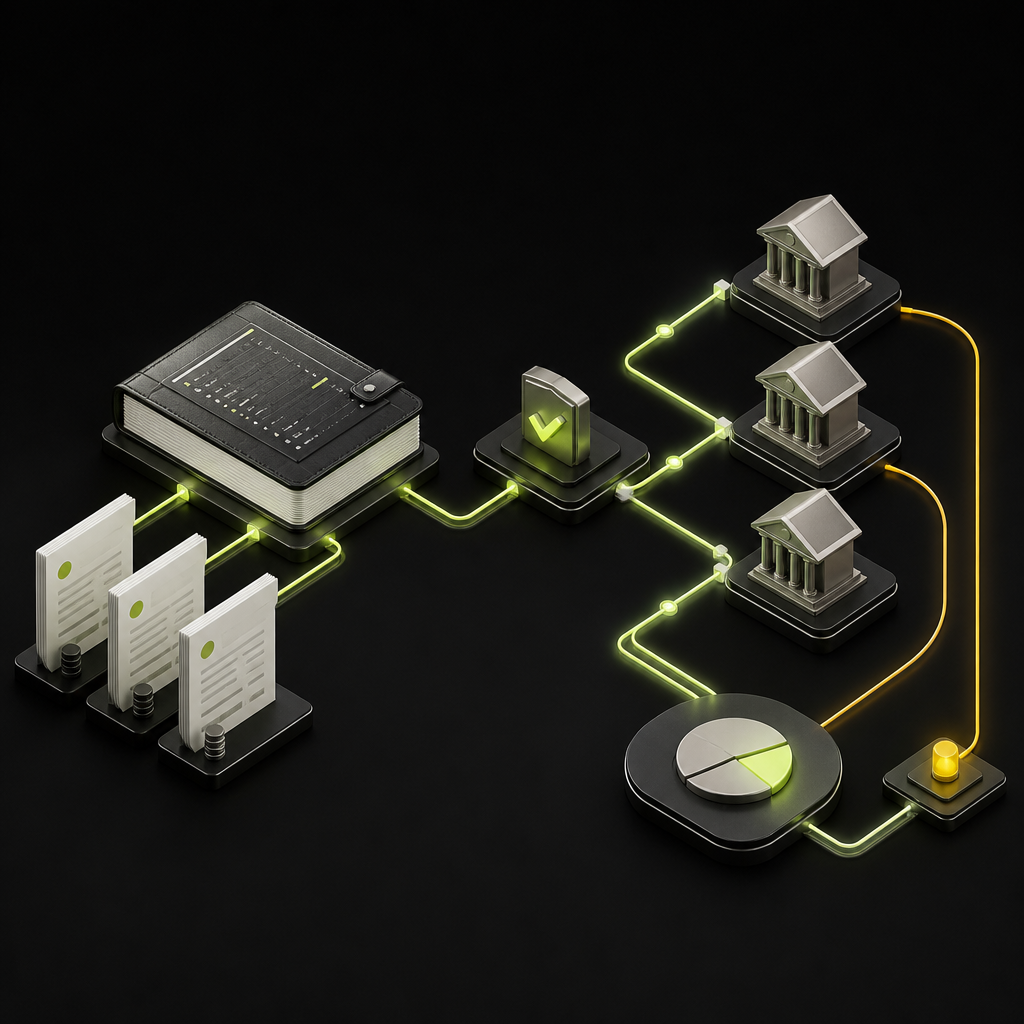
A useful system must connect these functions, whether it performs them directly or integrates with another application:
- Invoice readiness: approved amount, currency, entity, due date, and unresolved holds.
- Supplier readiness: approved payment destination, supported method, and required documentation.
- Release readiness: funding availability, authorized release, and applicable limits.
- Execution: submission, processing status, failures, and returns.
- Accounting completion: payment allocation, fees, currency differences, and reconciliation.
A bank portal can execute a transfer without knowing whether an invoice remains disputed. An invoice workflow can approve a liability without knowing whether the bank rejected its payment. The supplier payment system must connect those facts.
Create an ownership map before requesting proposals
Assign one authoritative owner to each business object. Other systems may display or update that object through controlled interfaces, but they should not independently decide its final state.
The following is a suggested ownership model, not a requirement to use separate applications. A unified platform may perform several roles.
| Record or decision | Suggested authority | Required handoff | Failure to prevent |
|---|---|---|---|
| Supplier identity and entity | Governed supplier master | Stable supplier identifier | Duplicate payees |
| Approved payment destination | Controlled supplier-data workflow | Approved destination version | Unreviewed bank changes |
| Invoice liability | ERP or accounting system | Open balance and credit allocations | Paying a closed invoice |
| Invoice approval | AP workflow | Decision and approved invoice version | Approval of stale data |
| Payment instruction | Supplier payment system | Unique instruction and attempt IDs | Duplicate submission |
| Execution evidence | Executing bank or provider | Referenced status events | Submission mistaken for settlement |
| Accounting reconciliation | ERP or reconciliation ledger | Allocated payment and cash evidence | Unexplained clearing balances |
Decide who can change each record, which changes require reapproval, and what happens when synchronization fails. Do not leave these decisions to implementation defaults.
When assessing ERP and accounting integrations, ask for the actual objects and directions supported. “ERP integration” may mean importing invoices, exporting journals, or maintaining bidirectional payment status. Those are materially different capabilities.
Separate invoice approval from payment state
Approved does not mean ready to pay
An approved invoice can still have an unresolved credit, an unverified bank change, a payment hold, or insufficient funding. Keep invoice approval distinct from payment eligibility.
Eligibility should be recalculated before release using the current invoice balance and approved supplier details. If a material field changes after approval, the system should apply the relevant reapproval policy rather than silently retaining an obsolete decision.
Submitted does not mean paid
Require documented definitions for statuses such as scheduled, submitted, accepted, settled, failed, and returned. Provider terminology varies, and not every payment method supplies the same evidence of beneficiary credit.
The interface should show what is known, where the evidence came from, and when it was received. An internal “complete” label should not imply confirmed supplier receipt when the available evidence only establishes acceptance by a payment provider.
One payment is not always one invoice
Supplier payments may combine invoices, deduct approved credits, or partially settle a balance. The system therefore needs an allocation record linking payment amounts to individual liabilities.
Keep invoice identifiers, payment instruction identifiers, provider references, and accounting document identifiers connected but distinct. This makes it possible to investigate a transfer without reconstructing its purpose from a bank-statement description.
Design for interrupted handoffs, not just successful ones
A credible supplier payment system must handle uncertainty between systems. Consider what happens when a provider accepts a payment but its response never reaches your application.
Automatically submitting a new payment could duplicate the transfer. Marking it failed could prompt an operator to pay it manually. Leaving it pending indefinitely obscures the liability and cash position.
Require these mechanisms:
- Idempotent submission: repeated requests with the same supported key should not create additional payments.
- Status recovery: query the existing instruction before deciding whether another attempt is necessary.
- Event controls: duplicate or late notifications must not incorrectly move a payment backward.
- Exception ownership: uncertain outcomes enter a queue with an owner and escalation path.
- Controlled resubmission: replacement attempts remain linked to the original instruction and its outcome.
These protections depend partly on the executing provider’s capabilities. Ask what happens when a rail lacks a reliable status query or cancellation mechanism. Our guide to failed-payment recovery explores the operational response once execution breaks down.
Keep touchless processing inside explicit boundaries
Invoice capture can reduce rekeying, while matching and routing rules can remove repetitive reviews. However, accurate extraction does not prove that goods were received, the supplier destination is legitimate, or funds should be released.
Quadient’s discussion of AP automation trends places AI, touchless processing, and fraud prevention alongside one another. For buyers, the practical implication is to evaluate automation and controls together rather than treating controls as a later configuration exercise.
Define an eligible population for touchless handling: invoices with acceptable source data, completed matching or permitted non-PO routing, no unresolved holds, and approved payment details. Route exceptions to named owners.
If AI proposes coding, resolves routine queries, or prepares payment actions, distinguish its proposal authority from its release authority. Faster preparation should not silently expand spending permission.
Measure the cost of the connected system
A lower subscription price can be offset by manual exports, payment investigations, or reconciliation work. Compare total operating cost using your own invoice and payment mix rather than a vendor’s headline savings estimate.
- Invoice processing cost: allocated capture, coding, matching, approval, and exception costs divided by invoices processed.
- Payment operating cost: release, execution, return handling, and reconciliation costs divided by payment instructions handled.
- Technology cost: licenses, implementation, connectors, support, and ongoing maintenance.
- Money-movement cost: transaction charges, FX costs, and other applicable rail or intermediary fees.
Keep cost definitions consistent before and after migration. Report invoice and payment metrics separately: consolidating invoices into fewer transfers changes payment volume without necessarily improving invoice processing.
Also track manual touches after approval, unresolved payment exceptions, and elapsed time to accounting reconciliation. These measures expose work that disappears from the AP dashboard but survives in spreadsheets.
A practical migration checklist
- Document ownership. Name the authoritative application and business owner for every record in the ownership map.
- Resolve starting data. Clean duplicate suppliers, confirm open balances, and identify pending payments and unapplied credits.
- Choose a bounded pilot. Use a defined entity, supplier group, and payment method before expanding scope.
- Control the cutover. Assign each liability to the old or new execution path. Parallel reporting can be useful; parallel payment release can create duplicates.
- Exercise exception paths. Include a changed destination, partial payment, provider timeout, returned transfer, and failed accounting update.
- Prove reconciliation. Trace invoices through payment allocation, cash movement, fees, and ledger entries.
- Set expansion criteria. Agree acceptable exception levels, support ownership, and rollback procedures before increasing volume.
Buy a connected operating model, not another dashboard
The right supplier payment system makes responsibility clear: which liability is payable, which destination is approved, what was submitted, what happened to the money, and what remains unreconciled.
Payouts.com brings AP automation, global money movement, and treasury into a financial operating system built around one ledger. Explore AP Automation with your ownership map and current exception list in hand. Use them to establish which workflows can be consolidated, which ERP responsibilities remain, and how every payment will return to the books.
Created with AI assistance. Sources are linked in the article; this content is general information, not legal, tax, or financial advice.
Discussion
31 commentsRelated resources

Multi Currency Payouts: A Failed-Payment Recovery Guide
A returned cross-border payment is not simply the original transaction in reverse. Learn how to preserve the recipient’s currency entitlement, manage FX differences, and retry payments without creating duplicates.
Sage Supplier Payments: Native Tools, Add-Ons, and AP Fit
Recording a supplier payment in Sage is not the same as executing and reconciling it. Here is how to evaluate native workflows and add-ons against your actual AP requirements.

Zimbabwe Supplier Payments in ZiG: An AP Control Guide
Zimbabwe’s ZiG supplier-payment directive concerns government procurement—not every private-sector invoice. Finance teams need transaction-level currency rules, funding checks, and settlement evidence before automating payment release.
Run your entire money cycle on one ledger
Global payouts, AP/AR automation, and AI agents with their own wallets and spend limits.
Get started
The ownership map is critical but I think the article underplays how hard it is to maintain when you're dealing with multiple entities across different ERPs. We have three regional instances and getting a stable supplier identifier that works consistently across all of them plus the payment layer has been a nightmare.
The distinction between payment readiness and invoice approval is something we only figured out after our first ACH run duplicated three payments because someone updated bank details between approval and execution. Now we have a separate payment release step that rechecks supplier data, but it adds friction that our AP team complains about constantly.
That extra release step is the right call. We do the same thing and treat it as a separate gate with its own audit log. The delay is worth it compared to explaining duplicate payments to suppliers and unwinding the mess in reconciliation.
We went through the same learning process. The extra release step does add friction, but we found we could automate most of it by setting a tolerance window—if supplier data hasn't changed in the past 72 hours and the invoice balance matches what was approved, it auto-releases. Manual review only triggers when there's a delta.
The bit about keeping invoice identifiers, payment instruction identifiers, provider references, and accounting document identifiers distinct but connected is something we got wrong in our first implementation. We let the payment provider generate the only reference ID and when they had an outage we couldn't trace which invoices were affected without manually matching amounts and dates from bank statements.
Exactly this. We now generate our own instruction ID before the payment leaves our system and pass it as metadata to the provider. Lets us query their API independently when callbacks fail or when we need to reconstruct what actually happened during an incident.
We made the same mistake and ended up building a wrapper that generates our own internal payment UUID before submission and maps it to the provider reference after they respond. Lets us track state even when their API goes dark.
The article assumes you have enough leverage to actually enforce this ownership model across vendors. In reality, most ERP and payment platform contracts don't let you dictate which system is authoritative for what—you're stuck with whatever their standard integration supports. How do you handle that when the software you already own fundamentally disagrees about who should control supplier master data?
You're right that you can't rewrite vendor contracts, but the ownership map still tells you where the gaps are. We use it to write compensating logic—like a nightly job that reconciles supplier bank details between the ERP and payment platform, flags differences, and forces manual review before release. It's not elegant, but at least we know where the risk sits.
Fair point, but you don't need vendor permission to define ownership internally. The map just forces your team to document which system you'll treat as the source of truth when there's a conflict, even if the vendor integration is messy. That clarity alone prevents half the reconciliation disasters we used to see.
The handoff failure scenarios are what killed our last implementation. We had assumed 'ERP integration' meant proper error handling and recovery, but it turned out to be a nightly batch export with zero retry logic. When the SFTP connection dropped mid-file we ended up with partial data in both systems and spent two weeks manually reconciling which invoices had actually been paid.
We had the same experience. The vendor kept saying they supported 'real-time sync' but it was just hourly batch with no state management. When we asked for idempotent key support they didn't even understand the question.
We learned to ask for a live demo of their retry mechanism during the sales cycle. If they can't show graceful handling of a mid-flight connection drop with proper idempotent resubmission, we walk away. Saved us from two vendors who had beautiful UIs but no actual error recovery.
The separation between invoice approval and payment eligibility hits hard. We've had multiple incidents where supplier bank details changed after approval but before scheduled payment date, and the old workflow just pushed it through because approval was green. Now we revalidate everything at execution time but it required custom logic that should have been native to the platform.
Same here. We now snapshot the approved supplier record at approval time and compare it against current data at release. Any mismatch triggers a manual review queue. Added 20 seconds to our process but prevented at least three incorrect wires in the last quarter.
We solved this by requiring a fresh supplier verification check within 24 hours of payment execution, not just at approval. If anything changed in the supplier master—routing, account number, even contact email—it forces a manual review before release. Added friction but zero misdirected payments since.
The point about allocation records linking payments to individual liabilities is underrated. We're still dealing with a legacy setup where combined payments only carry a single invoice reference, and reconstructing partial settlements during audits is a nightmare. Would be helpful to know if there's a practical threshold for when splitting payments becomes more trouble than it's worth.
We ended up requiring the payment system to write back structured allocation data to a custom object in the ERP rather than relying on memo fields. It's clunky but at least now every dollar has a traceable invoice linkage that survives the full cycle.
We enforced this by making allocation records mandatory at the payment layer before anything hits the bank. Each line references the original invoice ID and adjustment reason. It's extra overhead upfront but reconciliation time dropped by about 70%. The trick was getting our ERP to accept the allocation structure back without mangling it.
The ownership map framework is solid, but I wish there was more discussion on what happens when your ERP vendor insists they should own payment execution too. We're stuck in this argument right now with our NetSuite implementation partner who wants to keep everything native, but we know the payment rails and status tracking aren't robust enough for cross-border.
We went through this exact fight. Ended up drawing a hard line: ERP owns the liability and the ledger, payment system owns execution and status. The native NetSuite payment module couldn't handle idempotent retry or real-time status polling, so we kept it purely as GL record keeper and pushed all release decisions and provider communication to the payment layer.
We went through this exact fight. Ended up drawing a hard line: ERP owns the liability and the accounting record, payment layer owns execution and status. NetSuite can still trigger the payment, but it has to call out to the payment system and accept the status feed back. The partner hated it but we avoided the nightmare of NetSuite's built-in payment tracking trying to be authoritative for something it can't actually observe.
Idempotent submission should be table stakes but half the platforms we demoed couldn't clearly explain how they prevent duplicate payments when their webhook fails. If you're moving six figures daily this isn't a nice-to-have, it's a dealbreaker.
We started requiring vendors to demo their retry and recovery logic with a killed connection during the POC. You'd be surprised how many just said 'our system is reliable' instead of showing actual idempotency keys or reconciliation queries.
We built our own status reconciliation job that runs every 15 minutes to poll the provider API directly because we couldn't trust webhook delivery. It's extra infrastructure but cheaper than explaining a duplicate wire to the same vendor.
The ownership map section is exactly what we needed when we tried to stack Tipalti on top of NetSuite last year. We ended up with duplicate supplier records because no one decided up front whether the payment platform or the ERP was the master for vendor banking details. Took three months to clean up.
We had the exact same issue with banking details split between systems. What made it worse was that suppliers could update their info directly in the payment platform's portal, which then didn't sync back to NetSuite. Ended up with payments bouncing because the ERP had stale routing numbers.
We had the exact same issue with banking details split between systems. What made it worse was the payment platform cached supplier data locally, so even when we fixed records in the ERP, stale routing numbers kept getting used until someone manually refreshed. The ownership map would have forced us to answer which system sends the update versus which one just displays it.
I'd push back slightly on treating 'submitted does not mean paid' as a revelation. Any team that's dealt with ACH returns or international wires already knows this. The harder problem is getting non-finance stakeholders to understand why a payment shows 'complete' in the tool but the supplier is still calling about non-receipt two days later.
Completely agree. We've started maintaining a separate internal status field that only updates on settlement confirmation, and the vendor-facing portal shows that instead of the payment rail's intermediate states. Cuts down on the 'but your system says it's done' support tickets.
Agree, but that's actually the point. The article isn't written for AP teams who've been burned by this, it's for finance leaders buying their first automation platform who assume software status labels are legally meaningful. I've sat through three vendor demos where the sales engineer genuinely didn't know the difference between their internal state machine and what the bank confirms.