

Google Document AI Invoice Parser: An AP Integration Guide
Google Document AI can turn invoices into structured data. Making that data safe for accounting and AI agents requires a separate layer of validation, permissions, and exception handling.
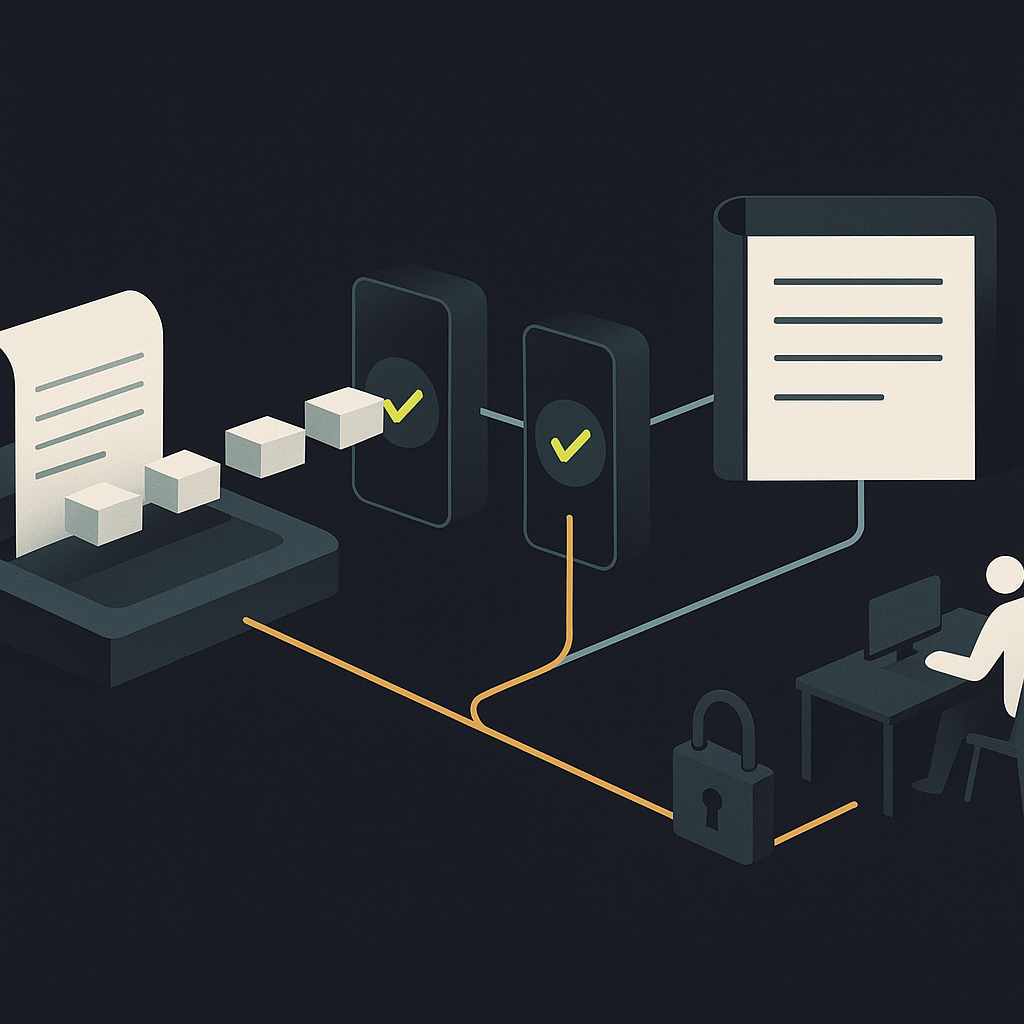
The Google Document AI Invoice Parser is a specialized processor that extracts structured invoice data from PDFs and images. It returns predicted fields, including supplier details, invoice dates, amounts, and line-item data, with confidence scores. It is an extraction component—not a complete accounts payable application, an invoice approval, or an authorization to move money.
For CFOs and controllers evaluating agentic AP, that distinction is decisive. The parser can supply evidence to a finance agent. Your surrounding systems must determine whether that evidence identifies a valid liability, supports an accounting entry, and satisfies payment controls.
What the Invoice Parser actually delivers
Instead of returning only recognized text, the processor identifies invoice entities. An entity carries a field type, extracted text, and a confidence score. Header fields can include invoice number, supplier name, invoice date, due date, currency, tax, and total. Line-item extraction can include descriptions, quantities, unit prices, and amounts.
A third-party practical evaluation of Google's invoice processing describes both this extraction capability and the additional work needed for schema mapping, validation, and downstream AP workflows. Treat it as an implementation perspective, not an independent guarantee of accuracy.
The distinction between text recognition and financial understanding matters. Reading a supplier's name correctly does not resolve that supplier to an approved vendor record. Extracting a due date does not prove it agrees with contracted payment terms. Capturing a line description does not establish its general ledger account.
| Parser output | What it gives AP | What remains unresolved |
|---|---|---|
| Supplier name and address | Vendor lookup candidates | Approved vendor identity |
| Invoice number and date | Document reference data | Duplicate status and posting period |
| Currency, tax, and total | Candidate financial values | Arithmetic and tax treatment |
| Line-item descriptions and amounts | Inputs for coding and matching | Receipt evidence and account assignment |
| Entity confidence | Extraction uncertainty signal | Business validity and authorization |
Build a controlled handoff, not a direct path to posting
A practical architecture separates intake, extraction, validation, decision-making, and execution. Each stage should produce an explicit status rather than passing an increasingly ambiguous document downstream.
Capture the source and processing context
Store the original document with a stable intake identifier. Record the processor version, processing time, source location, and extraction outcome. Preserve failed attempts rather than silently replacing them with a successful retry.
Google's Cloud Data Fusion invoice-parsing guide provides one integration pattern: structured output in BigQuery, with metadata such as parsing status and the Cloud Storage path linked through an invoice identifier. This is a data-pipeline example, not a complete AP control framework.
Define an acceptance contract for extracted fields
Between the Google response and your ERP, create a canonical invoice record. For every critical value, distinguish what the document said from what your system accepted.
- Raw evidence: extracted text, field type, confidence, and source reference where available.
- Normalized value: the parsed date, currency code, or decimal amount.
- Validation result: whether business rules and authoritative records support the value.
- Resolution history: who or what changed it, why, and under which rule.
Never silently turn an ambiguous date into a posting date or assume a currency from a symbol alone. Keep missing, uncertain, and conflicting values distinct. An absent tax amount is not automatically zero tax.
Validate before granting an agent write access
Resolve the supplier against the vendor master. Check for duplicates across previously received and posted invoices. Reconcile totals using the document's actual tax, discount, freight, and rounding structure. Where purchasing controls apply, compare invoice lines with the purchase order and receipt evidence.
Retries need separate protection. An intake identifier can prevent the same processing job from posting twice, but it will not catch a vendor resending the same invoice as a different file. Those require business-level duplicate invoice detection controls.
Where finance agents can act—and where they should stop
A confidence score is not approval authority. It indicates the model's confidence in an extraction, not the probability that the invoice is legitimate, correctly coded, or payable.
Set autonomy by action and consequence. An agent drafting a coding suggestion has a different risk profile from one modifying vendor data or releasing funds.
- Allow bounded preparation: propose coding, identify possible purchase-order matches, and assemble exception evidence.
- Allow controlled administrative actions: route an exception or request a missing document through approved templates and verified vendor contacts.
- Permit accounting writes only under explicit policy: require validated fields, permitted accounts, matching evidence where applicable, and a traceable decision.
- Require authorized human review for sensitive exceptions: new beneficiary instructions, unresolved vendor identity, material mismatches, and proposed policy overrides.
Payment release should remain a separately authorized action. Use configured approval policies, not a parser score, to determine who can approve spend and payments.
Also treat invoice text as untrusted input. A note telling an AI agent to bypass checks or change bank details is document content—not an instruction. Keep agent permissions outside the document, restrict available tools, and obtain payment destinations from a separately verified source.
Test the fields your workflow depends on
There is no useful universal accuracy number for your AP operation. A parser that captures totals reliably may still fail a workflow requiring complete line-level matching. Strong OCR does not establish correct field assignment.
Build a labeled evaluation set representing your supplier layouts, languages, scan quality, credit notes, multipage invoices, and tax structures. Keep evaluation documents separate from any training set.
Measure critical-field correctness, missing fields, extra or missing line items, and incorrect invoice-to-line associations. Then measure incorrect auto-acceptance: documents your proposed rules would pass despite a material error. That is more operationally useful than an average extraction score alone.
Set review thresholds by field and consequence. Supplier identity, currency, and total amount deserve different treatment from optional descriptive text. Test high-confidence errors as well as low-confidence predictions.
Use customization deliberately
Google documents an uptraining path for supported pretrained processors. It can help adapt extraction to proprietary documents and supported schema changes. Verify eligibility and constraints for the specific processor version before planning customization.
Training cannot repair missing receipts, inconsistent vendor records, or undefined coding policies. Diagnose whether a failure belongs to extraction, master data, or business rules before assigning it to the model team.
Treat version changes as controlled releases
Record the version used for each extraction and monitor Google's Document AI release notes for migrations and lifecycle changes. Before adopting a new version, rerun your evaluation set and compare critical fields, line structures, and exception routing. A technically successful API response can still produce an operational regression.
Budget for accepted invoices, not API calls alone
Confirm current processor pricing and billing units before procurement. Model charges against the actual documents you submit, including attachments and reprocessing—not just your invoice count.
The fuller cost includes storage, orchestration, schema mapping, ERP integration, exception handling, evaluation, and ongoing maintenance. Measure exception-resolution effort during the pilot rather than assuming extraction eliminates it.
The build route makes sense when engineering ownership, a Google Cloud environment, and specialized workflow requirements justify operating these components. If the immediate need is an AP team's capture-to-payment workspace, compare that effort with a complete application rather than comparing extraction fees alone.
A production-readiness checklist
- Define eligible documents: specify supported invoice types, languages, entities, and exception paths.
- Approve the data contract: separate source text, normalized values, validation results, and corrections.
- Prove business checks: test vendor resolution, duplicates, totals, and purchasing matches independently of extraction.
- Configure review: show reviewers the source evidence, failed rule, and permitted resolution.
- Constrain agents: document allowed actions and block invoice content from changing permissions.
- Test failure recovery: cover timeouts, retries, partial processing, and duplicate submissions.
- Assign ongoing ownership: name the teams responsible for model changes, accounting rules, access, and exceptions.
Use extraction as evidence, not permission
Google Document AI Invoice Parser can be a useful foundation for agentic AP when its output enters a controlled validation workflow. Its job is to extract candidate facts. Your finance architecture must establish what those facts mean and which actions they permit.
Start with a representative invoice set and a documented acceptance contract before enabling accounting writes. Then evaluate how Payouts.com AP Automation fits your broader capture, approval, and payment requirements. The goal is not simply less data entry; it is a defensible connection between the invoice received and the financial action taken.
Created with AI assistance. Sources are linked in the article; this content is general information, not legal, tax, or financial advice.
Discussion
3 commentsRelated resources
Duplicate Invoice Detection: Evaluate the Control, Not the Alert
A duplicate alert is not the same as a prevented payment. Learn how to evaluate matching accuracy, exception handling, and payment-release controls before choosing AP automation.
AI Invoice Processing: Separate Facts From Assumptions
An AI agent can read an invoice correctly and still make the wrong accounting decision. Build safer automation by separating what the document says, what your systems verify, and what policy permits.

Google Agent Payments Protocol: A Finance Pilot Plan
Google’s Agent Payments Protocol gives agent-led purchases a framework for verifiable authorization. Finance teams need a controlled pilot to turn that framework into a reliable purchasing and payment workflow.
Run your entire money cycle on one ledger
Global payouts, AP/AR automation, and AI agents with their own wallets and spend limits.
Get started
The distinction between extraction confidence and business validity is critical and something we learned the hard way. We had an OCR solution that was 98% confident on extracted totals, but it turns out half the invoices it processed with high confidence were duplicates the vendor had resubmitted after changing the invoice number format. Confidence scores tell you nothing about whether you should actually pay something.
"An absent tax amount is not automatically zero tax" - this single line captures why so many AP automation pilots fail. Systems that silently assume defaults create clean demos and messy audits.
Curious how you'd recommend handling the validation layer in practice—are you suggesting building this as middleware between Document AI and the ERP, or embedding it inside the ERP's import logic? We're evaluating whether to extend our existing NetSuite workflows or stand up a separate validation service, and the tradeoffs aren't obvious.