

Payables Automation: Build a Defensible Business Case
The strongest payables automation business case measures work eliminated—not just invoices captured. Here’s how to compare options without overstating savings.
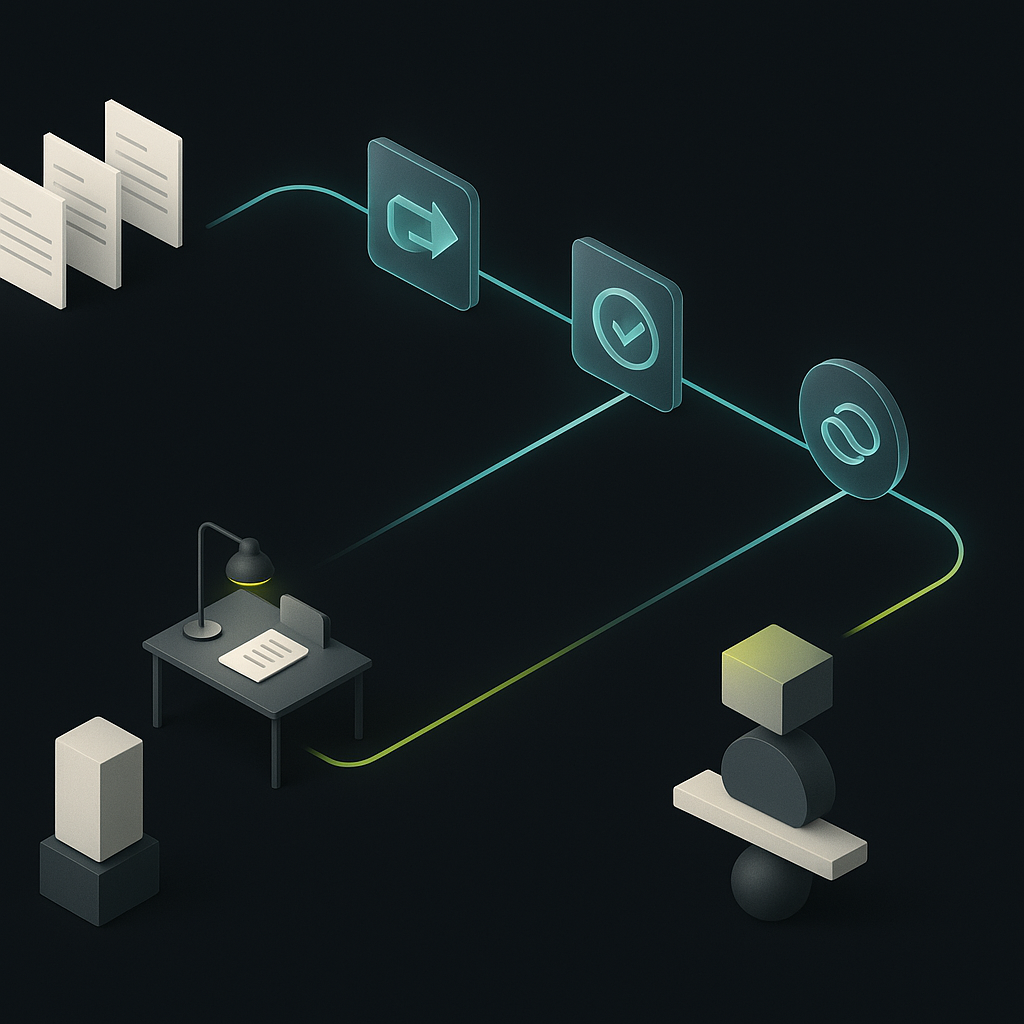
Payables automation uses software to capture invoice data, apply validation and approval rules, and coordinate posting, payment, and reconciliation. For finance teams comparing options, the business case should measure how much work disappears across that cycle, what controls remain, and what the new operating model costs.
A faster invoice reader is not necessarily a cheaper payables operation. If staff still chase receipts, rebuild payment files, and reconcile statuses manually, automation may simply move the workload. Evaluate the cost of the operation after implementation—not just the capabilities of the software.
Start with the work that survives automation
A useful evaluation question is: after a normal invoice enters the system, who still needs to do what?
Map each manual intervention from receipt through reconciliation. Include AP staff, department approvers, procurement, treasury, and IT. Otherwise, apparent savings in AP can hide new work elsewhere.
Separate the current workload into three categories:
- Removable work: rekeying invoice fields, forwarding approval emails, and copying approved payment data between systems.
- Reducible work: coding, matching, supplier inquiries, and reconciliation that can become exception-driven.
- Retained judgment: resolving disputed services, authorizing policy exceptions, and investigating suspicious payment-detail changes.
This distinction matters when evaluating AI. IFOL’s global research, published in partnership with SAP Concur in June 2026, reported that 19% of organizations were using AI within AP, with another 30% planning adoption within the next 12 months. Those survey findings describe adoption, not guaranteed labor savings or processing accuracy.
Ask suppliers of automation software to explain which tasks their AI performs, which require review, and where rejected or uncertain outputs go. An extracted field creates value only when it can safely support the next decision.
Define cost per invoice before comparing proposals
Cost per invoice is useful only when the numerator and denominator describe the same operation. An invoice-to-post metric cannot fairly be compared with an invoice-to-reconciliation metric.
Maintain two views: an invoice-processing cost that ends at ERP posting, and a broader payables operating cost that includes payment preparation, exception handling, and reconciliation.
Invoice-processing cost per invoice = attributable intake, validation, approval, and posting costs ÷ invoices posted during the measurement period.
Include allocated labor, relevant software costs, outsourced processing, and rework. Track invoices still awaiting resolution separately so that a growing backlog does not disappear from the analysis. For the broader operating view, add downstream labor and technology costs; show transaction fees and FX costs separately rather than burying them in an efficiency metric.
| Measure | Consistent definition | What it reveals |
|---|---|---|
| Processing cost per invoice | Attributed processing costs ÷ invoices posted | Unit economics before payment |
| Human handling time | Active work across all involved teams | Labor demand, not waiting time |
| Approval elapsed time | Ready for approval to final decision | Routing and availability delays |
| Exception workload | Case volume and handling time by cause | Where residual effort concentrates |
| Touchless processing rate | No-intervention invoices ÷ defined population | Automation coverage within scope |
| Unreconciled payment backlog | Open items and age at period end | Downstream work left unfinished |
Report results by invoice segment as well as overall. Purchase-order invoices with recorded receipts have different economics from non-PO services invoices, credits, and disputed charges. A changing invoice mix can otherwise look like a software improvement.
Translate capabilities into workload reductions
Invoice capture: measure review effort, not field extraction alone
Capture software may extract supplier names, totals, tax, and line items. The economic question is whether those outputs arrive complete and reliable enough for validation and posting.
Measure the time needed to correct documents, identify the right supplier record, assign accounting dimensions, and resolve missing information. A header-only extraction result may look successful while leaving substantial line-level work untouched.
Approval workflows: distinguish routing delays from business disputes
Rules can send invoices to the correct budget owner, escalate overdue decisions, and apply authorized delegation. ApprovalMax’s discussion of AP automation trends identifies granular routing and approver substitution as ways to address workflow bottlenecks.
But automated reminders cannot establish whether disputed consulting work was delivered. Separate avoidable delays caused by unclear ownership from delays that require a commercial decision. Assigning an exception owner and a resolution path is often more valuable than adding another notification.
Payment and reconciliation: account for the remaining handoffs
An approved invoice can still require manual payment preparation, funding checks, bank-portal entry, and ledger updates. Include those tasks in the business case even if a vendor’s quoted scope ends at posting.
Evaluate ERP and accounting integrations as operational dependencies, not checkboxes. Establish which system owns each record, how failed updates surface, and who resolves mismatched payment statuses. A connector that requires daily spreadsheet repair carries an ongoing operating cost.
Separate capacity, cash savings, and working-capital effects
Saved time does not automatically reduce expenditure. A defensible proposal gives each benefit a distinct treatment.
- Cash-releasing savings: spending that can actually stop, such as retired software, reduced outsourcing, or eliminated overtime.
- Capacity released: hours available for other work, without assuming an immediate payroll reduction.
- Future cost avoidance: hiring or external support that a documented volume forecast would otherwise require.
- Working-capital effects: changes to payment timing, discounts, and funding needs.
Do not count released employee hours as payroll savings and then count the same hours again as avoided hiring. Also, faster approval does not require earlier payment: it creates the option to pay at the economically appropriate time.
Early-payment discounts need their own analysis. Confirm supplier terms, eligible invoice volume, available liquidity, and the cost of funding before treating discounts as a benefit. Reduced fraud exposure is important, but it should not become an invented recurring savings figure.
Compare total operating cost, not subscription price
A lower software quote can leave more internal work behind. A broader platform can reduce handoffs but introduce migration effort, supplier changes, or capabilities your team will not use.
Require proposals to separate:
- Recurring charges: subscriptions, usage, entities, users, support, connectors, and payment-related fees.
- Implementation costs: configuration, integration, data cleanup, testing, training, and parallel operation.
- Retained operating costs: exception handling, workflow administration, supplier support, and integration monitoring.
- Transition and exit costs: legacy contract overlap, data exports, record retention, and future migration.
Steady-state annual net cash benefit = cash-releasing savings + substantiated avoided spending − incremental recurring costs.
Keep implementation spending and the adoption ramp separate when calculating payback. If the case depends mainly on released capacity, say so explicitly rather than presenting it as a cash-return calculation.
Use a residual-workload pilot to validate the case
A pilot should produce an operating model, not just a successful demonstration. Use a representative invoice population, including problematic documents and suppliers—not only clean PO invoices.
- Record the baseline. Measure active handling time, waiting time, backlog, and downstream work using consistent boundaries.
- Assign exception causes. Distinguish capture errors, missing receipts, coding questions, disputes, supplier-data issues, and integration failures.
- Observe displaced work. Record whether AP effort moves to approvers, procurement, treasury, or IT.
- Test control continuity. Confirm that approvals, holds, and relevant changes remain traceable through payment preparation.
- Recalculate the case. Use observed residual effort and actual quoted costs, with a downside scenario for slower adoption.
For touchless processing, state exactly where the measurement starts and ends. Automatic capture followed by manual coding is not touchless invoice processing; automatic posting followed by manual payment release is not touchless invoice-to-pay. Our guide to defining touchless invoice processing explores that distinction in more depth.
Hypothetical example: the cheaper quote costs more to operate
Suppose one proposal automates capture and email-based approvals but leaves payment-file creation and reconciliation with the finance team. Another connects those stages but has a higher subscription and greater implementation effort.
The broader option is not automatically better. If payment work is already efficient and the proposed integration needs extensive maintenance, the narrower option may be more economical. If repeated downstream handling drives the workload, the broader option may justify its cost. The decision depends on retained effort, not the longest feature list.
Make the next step an operating-cost review
The strongest payables automation proposal explains which work disappears, which remains, who owns exceptions, and how benefits will be measured after rollout. It also names the spending that will actually stop.
Bring your invoice segments, workload baseline, and integration requirements to an evaluation of Payouts.com AP Automation, which covers invoice capture, approvals, and payment. Use that scope to build a costed future-state workflow. Buy the operation your team can sustain—not an automation percentage detached from the work.
Created with AI assistance. Sources are linked in the article; this content is general information, not legal, tax, or financial advice.
Related resources
Touchless Invoice Processing: What It Really Means and How to Get From 0% to 80%+
Touchless invoice processing isn't a switch you flip — it's a rate you climb. Here's what it really means, how to measure it, and a step-by-step path from 0% to 80%+.
AI Invoice Processing Software: Test Accuracy Before Buying
A polished invoice demo does not prove production readiness. Learn how to test extraction, coding, and exception handling—and compare software on the cost of usable output.

Invoice Automation Platform: Buy for Your Invoice Mix
The right invoice automation platform depends on the invoices your team actually receives. Build a buying case around document complexity, exception workload, and the cost of reaching a correctly posted payable.
Run your entire money cycle on one ledger
Global payouts, AP/AR automation, and AI agents with their own wallets and spend limits.
Get started
Discussion
0 commentsBe the first to join the discussion.