

Procure-to-Pay Automation: Closing the Gap Between Purchase Approval and Payment Release
An approved purchase is not yet an authorized payment. Learn how to connect procurement, AP, and treasury without losing the evidence and controls between them.
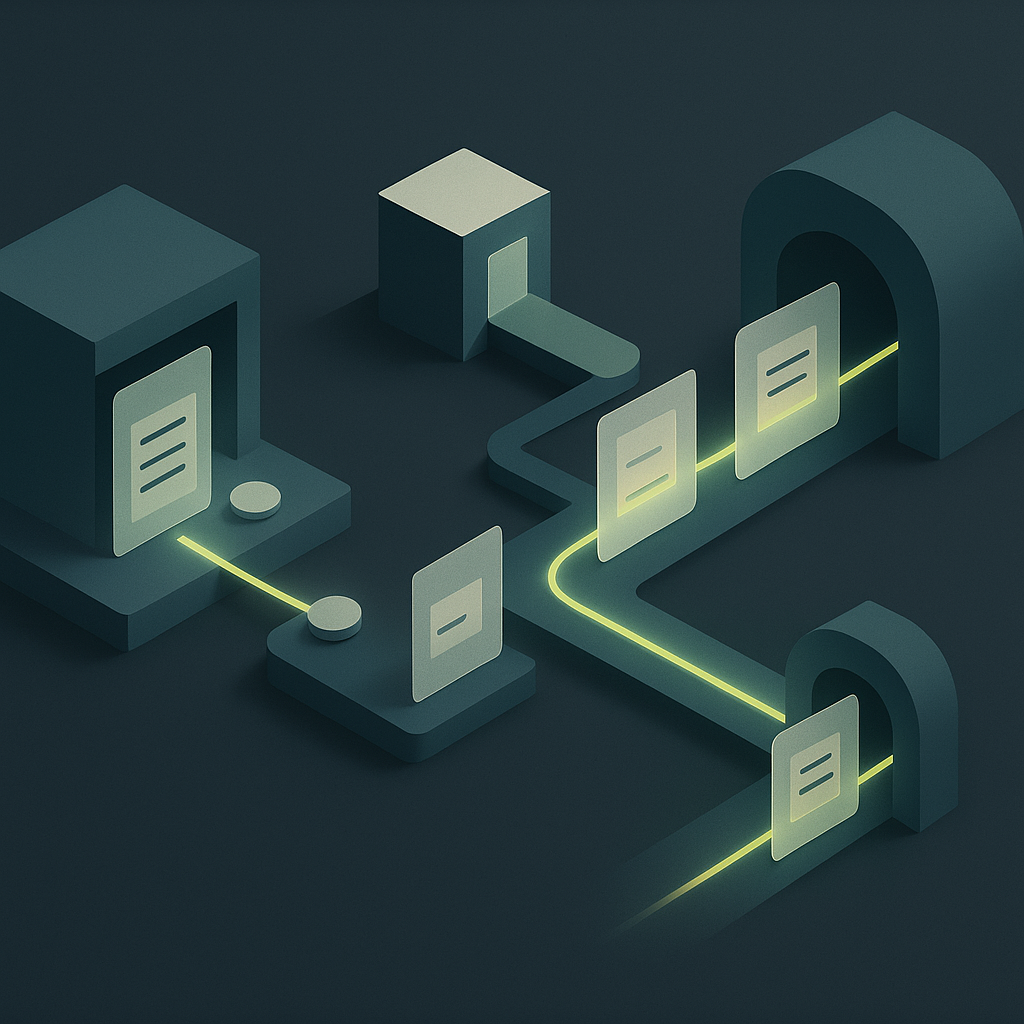
Procure-to-pay automation connects purchase requests, purchase orders, receiving, invoice processing, payment, and accounting in a controlled workflow. Closing the gap between purchase approval and payment release requires more than moving records between systems: each handoff must preserve what was authorized, what was received, what remains payable, and who can release the funds.
For finance teams comparing software, the decisive question is not whether the platform automates approvals. It is whether an approved purchase can become a reconciled payment without someone reconstructing its history in email, spreadsheets, or a bank portal.
Purchase approval is not payment authorization
IBM describes procure-to-pay as the process spanning requisitioning and purchasing through receiving, payment, and accounting. That breadth matters: AP automation may begin at invoice receipt, while P2P must preserve decisions made before the invoice exists.
Three decisions should remain distinct:
- Purchase approval: May the business commit to this supplier, scope, price, and budget?
- Invoice approval: Does the supplier's claim correspond to an authorized obligation and acceptable delivery?
- Payment authorization: May this amount leave this entity's account for this beneficiary now?
These decisions can reuse evidence without requiring identical human approvals. A compliant invoice against an approved order and recorded receipt may qualify for automatic processing under policy. A changed beneficiary or disputed delivery should not inherit that permission merely because the purchase was approved.
The objective is evidence reuse, not approval reuse without conditions. A detailed invoice approval workflow defines decision authority; the broader P2P design determines whether that authority survives each system handoff.
Define what each handoff must carry
Before selecting purchase-to-pay automation software, agree on the information and conditions required at each transition. A status such as “approved” is insufficient unless the receiving system knows which record version was approved and what that approval covered.
| Handoff | Evidence to carry | Condition that blocks progress | Exception owner |
|---|---|---|---|
| Request to purchase order | Entity, supplier, budget, approved scope | Commitment exceeds authorization | Procurement or budget owner |
| Order to receipt | PO line, quantity, delivery evidence | Missing or disputed acceptance | Receiving or service owner |
| Receipt to invoice approval | Invoice lines, receipt links, tolerances | Unresolved price or quantity variance | AP with procurement |
| Approved invoice to payment | Open balance, due date, beneficiary version | Hold, unverified change, insufficient funding | AP or treasury |
| Payment to reconciliation | Payment reference, outcome, allocation | Unknown, returned, or unmatched payment | Treasury or accounting |
Keep the evidence at line level
Header-level matching breaks down when an order contains different delivery dates, cost centers, or partially fulfilled items. Maintain links between PO lines, receipt or acceptance records, invoice lines, and credit adjustments.
Basware's P2P process explanation describes matching invoices against purchase orders and receipt information. In implementation, the critical detail is how matching handles incomplete delivery, not just perfect matches.
For services, the equivalent of a goods receipt might be milestone acceptance or an approved service-entry record. Non-PO invoices need a separate policy path; forcing them through a fictional purchase order obscures the actual control.
Separate eligibility from scheduling and execution
An invoice can be approved but not due, eligible but unfunded, or scheduled but subsequently placed on hold. Treat these as distinct states. Likewise, payment submission is not proof of beneficiary credit; preserve the payment provider's actual status and its meaning.
The scheduling engine should consider terms, holds, funding, and relevant processing cutoffs. Before dispatch, it should revalidate conditions that could have changed since scheduling.
Choose an architecture that preserves ownership
A unified suite can simplify shared records and workflow visibility, but may require procurement to change established buying processes. Connecting specialist tools can preserve those processes, but adds responsibility for synchronization, error handling, and monitoring.
Neither architecture removes the need to define the authoritative source for supplier identity, bank details, purchase commitments, invoice balances, and payment outcomes. APQC's analysis of P2P automation emphasizes governance and integration across procurement and finance rather than isolated task automation.
Evaluate procurement workflows and downstream payments together, even if different systems provide them. For each shared record, name its owner, permitted editors, synchronization direction, and conflict-resolution rule.
Make procurement payment integration failure-aware
A connector demonstration proves little if it only shows a successful transfer. Ask the vendor to show what happens when:
- An event arrives twice: Processing must not create a second payable or payment.
- Updates arrive out of order: An old approval must not overwrite a newer hold.
- A payment request times out: The workflow should establish whether it was accepted before attempting another instruction.
- A source record changes: Material changes should trigger the appropriate recheck, not silently inherit stale authorization.
When reviewing ERP and accounting integrations, require evidence of recovery queues, replay controls, and reconciliations between systems. Batch transfers can be workable, but their delay creates a window in which holds or supplier changes may not yet be visible downstream.
Hypothetical example: a partial delivery after an approved purchase
Consider an approved equipment order delivered in stages. The supplier invoices the full order, but receiving has accepted only the first shipment.
A disconnected workflow sends the invoice to the original budget approver, who recognizes the purchase and approves it. AP then exports the full amount to a bank portal. Each local step looks reasonable; collectively, they lose the distinction between purchase authorization and accepted delivery.
In an automated procure-to-pay process, the invoice matches against receipt evidence at line level. The undelivered portion becomes an exception. If contract terms and company policy permit partial payment, the workflow proposes the supported amount for authorization while preserving the unpaid balance and dispute status. Otherwise, it holds the invoice.
If the supplier changes payment details before release, beneficiary verification remains a separate requirement. That change should not require procurement to approve the equipment again, but it should prevent payment to an unverified destination.
This is the practical value of connected automation: resolve the changed condition without restarting unrelated decisions or ignoring the exception.
Use a cross-functional proof-of-work checklist
Evaluate vendors with a representative purchase journey, not separate procurement and AP demos. Include ordinary transactions and exception paths, and ask vendors to distinguish standard configuration from customization.
- Trace one purchase end to end. Follow its identifiers through order, acceptance, invoice, payment instruction, and accounting allocation.
- Amend the purchase after approval. Confirm that material scope or price changes receive the required authorization and retain version history.
- Introduce a delivery dispute. Verify that the correct owner receives the exception and that payment eligibility reflects the hold.
- Change a scheduled payment's inputs. Test a credit adjustment, beneficiary update, and funding shortfall before dispatch.
- Interrupt an integration. Require a recovery demonstration that preserves balances and prevents duplicate execution.
- Inspect the audit record. Look for linked evidence, policy versions, actors, timestamps, and override reasons—not just a final approval flag.
Include receiving and service owners in the evaluation. AP cannot automate evidence that nobody records. AI may extract invoice data or help classify exceptions, but inferred delivery should not replace required acceptance evidence.
Measure the gap, not just invoice speed
Track elapsed time from purchase approval to payment release, but separate legitimate waiting time from avoidable delay. Contractual payment terms are not an operational bottleneck.
Useful measures include:
- Eligible-to-release time: How long invoices wait after required evidence and authorizations are complete.
- Handoff exception rate: Transactions blocked by missing references, stale records, or synchronization failures.
- Approval reconstruction effort: Staff time spent retrieving evidence already captured elsewhere.
- Unreconciled payment age: Time payment outcomes remain unallocated to the corresponding liabilities.
For cost per invoice, define the boundary consistently: include exception handling and downstream payment administration if those costs form part of the business case. Otherwise, a faster invoice queue can hide work shifted to treasury.
Close the workflow before expanding automation
Start with a purchase category that has clear ownership and usable receipt evidence. Establish the handoff rules, prove exception recovery, and then expand. Automation should remove repeated data entry and redundant decisions—not erase distinctions between commitment, liability, and cash movement.
Payouts.com brings AP automation, global payouts, and real-time treasury into a financial operating system built around one ledger. Explore Payouts.com AP Automation with procurement and treasury at the table, using a purchase-to-payment journey to assess where your current systems need to connect.
Created with AI assistance. Sources are linked in the article; this content is general information, not legal, tax, or financial advice.
Discussion
34 commentsRelated resources
Invoice Approval Workflow: Build a Matrix That Holds Up
An effective invoice approval workflow defines who can approve, what evidence they need, and when approval must reset. Use this framework to turn an email-based process into enforceable rules.
Azure AI Invoice Processing: What Finance Must Build Around It
Azure can turn supplier invoices into structured data. The buying decision is whether your team can own the validation, exceptions, and ERP workflows that turn that data into approved payables.
Payables Automation: Build a Defensible Business Case
The strongest payables automation business case measures work eliminated—not just invoices captured. Here’s how to compare options without overstating savings.
Run your entire money cycle on one ledger
Global payouts, AP/AR automation, and AI agents with their own wallets and spend limits.
Get started
The failure scenarios section is spot-on, but I'd add one we hit hard: what happens when a supplier changes their bank account between PO approval and payment release? If the payment system just inherits the beneficiary details from the approved purchase without revalidation, you've built an automation highway for fraud or misdirected funds. We now require treasury to confirm beneficiary details within 48 hours of payment dispatch, regardless of how old the PO approval is.
We handle this with a beneficiary revalidation step that runs 24 hours before scheduled payment dispatch. If the supplier record shows any change timestamp after invoice approval, payment gets held for manual review. Not elegant, but it's caught fraudulent change requests twice in the past year.
We built a similar safeguard after a close call. Our payment system now flags any beneficiary detail change within 30 days of the original supplier setup, regardless of when it occurs in the P2P cycle. It's a simple date-based trigger but has caught two attempted fraud cases and several legitimate changes that would have bounced otherwise.
The part about invoice approval vs payment authorization finally gave me language to explain to our CFO why our treasury team keeps rejecting invoices that procurement already approved. We've been calling it 'dual approval' but it's really about three different control gates that happen to share some data. Bookmarking this for our next steering committee.
Exactly this. We had the same terminology problem until we mapped it explicitly: procurement says yes to the commitment, AP says yes to the claim, treasury says yes to the funds leaving. Once we stopped using 'approval' for all three, the conflict mostly disappeared.
We ended up documenting it as three sequential gates with different ownership: procurement owns commitment authority, AP owns invoice validity, treasury owns liquidity and timing. Once we gave each gate a named owner and split the approval histories in our audit trail, the friction dropped way down.
The question about what happens when updates arrive out of order is something I wish we'd asked our vendor before go-live. We have a procurement system that sends status changes via API, and our AP system occasionally processes a 'cancelled' event before the 'approved' one arrives. The vendor's answer was essentially 'don't let that happen' which is not a solution when you have no control over network timing.
We hit the same thing with idempotency keys. Our middleware now assigns a sequence number to every event as it arrives and holds processing until gaps are filled or a timeout expires. Not elegant, but it stopped the out-of-order chaos.
We had a similar issue with event ordering. Our solution was adding a versioning field to every status message so the receiving system can reject outdated events even if they arrive late. It's not elegant but it stopped us from reverting invoices that had already progressed downstream.
The point about approvals not surviving handoffs intact is something we're dealing with right now. Our procurement team approved a software renewal, but by the time it reached AP the vendor had merged with another company and changed bank details—yet the system still treated it as fully approved because the PO number matched. We're now retrofitting a beneficiary verification step between invoice approval and payment release that should have been there from day one.
The line about 'an approved purchase can become a reconciled payment without someone reconstructing its history in email, spreadsheets, or a bank portal' is painfully accurate. We just spent three days tracking down why a payment went to an old supplier account—turns out the bank details were updated in the ERP after the payment instruction was queued but before release, and nothing reconciled the versions.
We had the same root cause but different symptom—a supplier changed their remittance bank mid-cycle and the update sat in procurement's system for 48 hours before syncing to payments. The invoice was already queued with the old account. Now we require beneficiary changes to trigger an immediate sync and flag any queued payments for that supplier.
We had the same root cause but different symptom—a supplier changed their remittance bank after invoice approval but before payment release, and nothing flagged the change between systems. The article's point about revalidating conditions before dispatch would have caught it.
The section on separating eligibility from scheduling is underrated. We had invoices marked approved that were still being paid on the wrong date because the scheduler didn't distinguish between 'cleared to pay' and 'due to pay.' Adding a funded/unfunded state in between approval and execution cut our early payment leakage by about a third.
We ended up treating funded/unfunded as a gate rather than just a state flag. Treasury gets a daily batch of approved items due within the funding window, and they explicitly release tranches. It's an extra step, but it stopped the autopay blowouts when our credit line was tapped out mid-week.
We hit this too. The real pain point came during month-end when treasury needed a forecast of outflows but the ERP was showing everything approved as if it would all go out tomorrow. Adding a 'scheduled but pending funding review' status gave treasury actual breathing room to manage liquidity instead of scrambling.
The architecture choice section glosses over a critical tension: unified suites often can't handle complex procurement workflows (approvals by project phase, multi-entity requisitioning, etc.), but stitching together specialist tools means you're permanently on the hook for maintaining that integration layer. We went the integrated route and are now rewriting procurement logic to fit the ERP's rigid approval trees. Would genuinely like to hear from anyone who's kept best-of-breed procurement and successfully bridged it to treasury without building a full-time integration team.
We're living this right now. The unified suite vendor promised they'd adapt their approval engine to our multi-phase capital project workflow, but nine months in we're still waiting on custom development that may never come. Meanwhile the integration tax with our old procurement tool keeps growing because nobody wants to fund proper monitoring and reconciliation between systems.
We faced exactly this and ended up with a hybrid: procurement stayed in their specialist tool, but we built a thin integration layer that enforces the handoff rules described in the article. It's not zero maintenance, but at least the failure modes are ours to fix rather than waiting on a suite vendor's roadmap.
The handoff table is exactly the artifact we needed six months ago when our procurement and AP teams were arguing about who owns invoice holds. We ended up mapping it ourselves after two failed kickoffs, but having 'exception owner' spelled out by process step would have saved us weeks of politics and three separate RACI documents.
We had a similar standoff. What finally unstuck it for us was forcing both teams into the same room with the CFO and walking through a single invoice from PO to payment while screen-sharing each system. Turns out neither side knew what fields the other actually needed to make a hold decision stick across the boundary.
We had a similar standoff. What finally unstuck it for us was forcing both teams into the same room with treasury and literally walking through a disputed invoice end to end. Turns out procurement thought AP owned anything post-PO, and AP thought procurement still owned anything with a variance. The missing piece was defining what triggers the handoff, not just who takes it.
The point about non-PO invoices needing a separate policy path instead of forcing them through a fictional PO really resonates. We've been wrestling with utility bills and professional services getting stuck in our P2P tool because someone decided everything must map to a purchase order. The workarounds people create—dummy POs, blanket orders with no real matching—end up creating more risk than just having a clean exception workflow with appropriate controls.
We solved this by creating a lightweight approval path that bypasses the PO match entirely but still enforces GL coding and dual approval based on amount thresholds. The trick was getting procurement to accept that not everything flows through their system without losing spend visibility.
Exactly. We ended up classifying recurring low-value, no-PO invoices separately and routing them through a simplified approval chain tied to GL account and threshold, not procurement workflow. Trying to retrofit them into PO logic just created fake requisitions that cluttered reporting and confused audit trails.
I'd push back slightly on line-level matching being universally necessary. For smaller mid-market companies processing under 500 invoices monthly, the overhead of managing PO line receipts versus header matching doesn't always justify the control improvement. The real question is risk tolerance and materiality, not a one-size-fits-all answer.
Fair point on volume, but I'd argue the risk isn't just about control—it's about disputes. We're mid-market and line-level matching saved us multiple times when suppliers invoiced for items still in transit or disputed quantities. Without it, AP becomes the detective every time there's a variance.
Fair counterpoint, but even at lower volumes I've seen line-level matter when partial shipments hit. If your vendors ship complete orders consistently, header matching is probably fine. The problem shows up when you scale or add suppliers with less reliable fulfillment.
The distinction between purchase approval and payment authorization is something we've struggled to articulate to our ERP vendor. They keep treating approved POs as blanket permission to pay whatever invoice arrives, which completely bypasses our treasury policy on payment release timing and beneficiary verification. This framework gives me the language I need for that conversation.
We had the exact same conversation with our vendor. What finally worked was showing them a scenario where beneficiary details changed between PO approval and invoice receipt—suddenly they understood why payment authorization needs its own gate. The article's three-decision framework would have saved us weeks of argument.
We encountered this exact problem and ended up building a workflow layer between procurement and treasury that requires explicit payment release even when the invoice matches the PO perfectly. It added a step but gave us the control point we needed for cash management and fraud prevention.
The failure-aware integration section is gold. We just went live with a new P2P connector last quarter and discovered exactly the duplicate payable problem when webhook retries created two records for the same invoice. Now we're retrofitting idempotency keys that should have been scoped from day one.
We learned the same lesson during implementation. Our vendor insisted their retry logic was bulletproof, but under load we saw duplicate payables until we forced uniqueness constraints at the database level and added deduplication middleware. The real test isn't the happy path demo, it's what happens when the network hiccups during month-end close.
Same issue here. Our procurement system sends a confirmation webhook, then a second one when the PO is fully synced, and AP treated them as two separate invoices until we added deduplication logic based on PO number and line hash. The vendor's documentation didn't even mention retry behavior.